
Many workplace injuries and cases of work-related ill health occur in offices which are often perceived as low risk. Carrying out an office risk assessment helps employers identify potential hazards, meet legal duties, and implement practical measures to reduce risks before incidents occur.
Here we discuss the legal requirements for office hazards risk assessments, the most common hazards to be aware of, and practical steps to create a safer and healthier workplace. We also provide a downloadable template you can adapt to your office, with guidance to help you fill it in.
What is an office hazards risk assessment?
An office hazards risk assessment is the structured process of identifying hazards in an office, assessing the likelihood and severity of harm, and determining what control measures are needed to reduce risks.
A suitable office risk assessment should consider:
Hazards in the workplace
Common office hazards may include trailing cables, poor workstation setup, overloaded electrical sockets, blocked walkways, slips and trips, unsuitable storage arrangements, manual handling activities, poor lighting, stress, and fire risks.
Hazards may also arise from work practices, equipment, or the physical condition of the workplace.
Who may be harmed and how
The assessment should identify who could be affected by the hazards and how harm could occur. This may include employees, temporary workers, contractors, cleaners, visitors, pregnant workers, or individuals with disabilities or specific health needs.
Consideration should also be given to people who may be more vulnerable to particular risks, such as inexperienced staff or those with pre-existing medical conditions.
The likelihood of an incident occurring
Likelihood is the chance of an incident or ill health occurring because of a hazard. This should be assessed by considering factors such as:
- How often the hazard is encountered
- How many people are exposed to the hazard
- How the task is carried out
- The condition of equipment
- Previous incidents or near misses
- Whether existing controls are reliable and consistently followed.
For example, a loose cable across a frequently used walkway may present a high likelihood of a trip because many people pass through the area each day. In contrast, a hazard located in a restricted area with limited access may present a lower likelihood.
Many organisations use a simple scoring system:
- Low likelihood – unlikely to occur under normal conditions
- Medium likelihood – could occur occasionally
- High likelihood – expected to occur if no further controls are implemented
The severity of potential injuries or ill health
Severity considers how serious the outcome could be if an incident occurs. In an office this may range from minor injuries, such as cuts or bruises, to more serious outcomes including musculoskeletal disorders, stress-related ill health, fractures from falls, or injuries caused by fire or electrical faults.
Severity should consider the worst credible outcome, particularly where vulnerable persons may be affected.
Here is a simple severity scale:
- Low severity – minor injuries requiring little or no treatment
- Medium severity – injuries requiring medical treatment or time away from work
- High severity – serious injury, long-term ill health, or fatality
Existing control measures
Any controls already in place to reduce risks should be reviewed to determine whether they are suitable, effective, and consistently applied.
Existing controls may include workstation assessments, staff training, housekeeping arrangements, maintenance procedures, fire safety measures, display screen equipment controls, supervision, and safe systems of work.
The assessment should consider whether these measures adequately reduce the risk or whether gaps remain.
Additional actions required
Where existing controls are not sufficient, further actions should be identified to reduce risks to an acceptable level. This may include introducing new procedures, improving housekeeping, providing additional training, repairing defects, replacing equipment, improving ergonomics, or increasing supervision and monitoring.
Actions identified should be realistic, prioritised according to the level of risk, and assigned to responsible persons with clear completion timescales.
Why is an office risk assessment important?
Employers have a legal duty to identify workplace hazards, assess risks, and implement suitable control measures to protect employees and others from harm.
Under the Management of Health and Safety at Work Regulations 1999, Regulation 3 employers must carry out a “suitable and sufficient” assessment of workplace risks. Organisations with five or more employees must also record the significant findings in writing.
Office risk assessments also support compliance with wider health and safety legislation, including:
- Health and Safety at Work etc. Act 1974, Section 2, which requires employers to protect the health, safety, and welfare of employees.
- Workplace (Health, Safety and Welfare) Regulations 1992, which require employers to maintain safe workplace conditions, including lighting, ventilation, traffic routes, cleanliness, and welfare facilities.
- Health and Safety (Display Screen Equipment) Regulations 1992, which require employers to assess and reduce risks associated with DSE workstations and workstation use.
- Regulatory Reform (Fire Safety) Order 2005, which requires organisations to carry out fire risk assessments and implement appropriate fire precautions and emergency procedures.
Unmanaged office hazards can lead to long-term suffering for the individual, reduced productivity and legal claims. HSE statistics for 2024/25 reveal that a total of 40.1 million working days were lost due to work-related illness and workplace injury.
What are the most common office hazards?
These are the most common office hazards to prioritise in a risk assessment.
Slips, trips and falls
Slips and trips account for around 30% of non-fatal workplace injuries reported by employers each year, highlighting the importance of controlling these risks effectively.
Common office slip and trip hazards include trailing cables, wet floors, damaged carpets or flooring, poor housekeeping, cluttered storage areas, and obstructed walkways. Poor lighting and unsuitable footwear can also increase the likelihood of an incident occurring.
Practical control measures include:
- Installing cable management systems to prevent trailing wires
- Cleaning spillages promptly and displaying warning signage where necessary
- Carrying out regular workplace inspections to identify hazards
- Repairing damaged flooring and securing loose carpets
- Keeping walkways, exits, and stairways clear at all times
- Ensuring adequate lighting throughout the workplace
- Encouraging good housekeeping standards among employees
- Providing Slips, Trips and Falls Training so employees can identify and address risks.
Since slips and trips are so common and often easily preventable, they are one of the most important hazards to address.
Display screen equipment (DSE)
Work-related musculoskeletal disorders (MSDs) affect hundreds of thousands of workers each year and are one of the leading causes of work-related ill health in the UK.
Prolonged use of poorly designed display screen equipment (DSE) workstations can contribute to back pain, neck and shoulder strain, repetitive strain injuries, eye strain, headaches, and fatigue.
Common DSE hazards include incorrect chair height, poorly positioned monitors, inadequate desk space, poor posture, unsuitable keyboard and mouse placement, and failure to take regular breaks from screen-based work.
Practical control measures include:
- Carrying out DSE workstation assessments for employees
- Providing adjustable chairs and suitable workstation equipment
- Positioning monitors at an appropriate height and distance
- Ensuring sufficient desk space and appropriate lighting
- Providing separate keyboards, mice, or laptop stands where necessary
- Encouraging employees to change posture and take regular breaks from screen work
- Providing Display Screen Equipment Training on correct workstation setup and ergonomic practices
As many office workers use computers for prolonged periods each day, it is vital to assess DSE risks during an office hazards risk assessment.
Stress and mental health risks
According to the Health and Safety Executive (HSE), 964,000 workers suffered from work-related stress, depression, or anxiety in 2024/25, resulting in 22.1 million working days lost.
In office environments, psychosocial hazards can develop from excessive workloads, poor communication, lack of managerial support, bullying or harassment, unclear job roles, and long working hours. Prolonged exposure to these factors can negatively affect employee wellbeing, performance, attendance, and productivity.
Practical control measures include:
- Monitoring workloads and working hours
- Encouraging open communication and regular check-ins
- Providing clear roles, responsibilities, and expectations
- Training managers to recognise signs of stress and poor mental wellbeing
- Providing access to wellbeing support or employee assistance programmes
- Addressing bullying, harassment, and workplace conflict promptly
- Carrying out stress risk assessments where appropriate
At Praxis42 we offer two courses to help manage stress in the workplace: Stress Awareness for Managers and Stress Awareness for Employees.
Further office hazards
Office risk assessments should also consider electrical safety, fire risks, and manual handling activities. These hazards can result in serious injuries and significant property damage.
Electrical hazards
Offices rely heavily on electrical equipment, including computers, monitors, printers, chargers, kettles, and extension leads. Faulty or poorly maintained electrical equipment can lead to electric shock, burns, and workplace fires.
Common office electrical hazards include overloaded plug sockets, damaged power cables, faulty appliances, unsafe use of extension leads, and inadequate maintenance of electrical equipment. Poor cable management can also create additional slip and trip hazards.
Many organisations also carry out Portable Appliance Testing (PAT) as part of their wider office risk assessment and equipment maintenance process.
Fire safety risks
According to UK government fire statistics, fire and rescue services attend thousands of non-domestic building fires each year, including fires in offices and commercial premises.
Office fire hazards include faulty electrical equipment, overloaded sockets, poorly stored combustible materials, blocked fire exits, unsafe use of portable heaters, and inadequate emergency procedures. Poor housekeeping and failure to maintain fire safety systems can also increase the likelihood and severity of a fire.
Since fires can spread quickly and have serious consequences, it is important to address this during an office risk assessment.
Manual handling hazards
Although offices are generally considered low-risk environments for manual handling, injuries can still occur when employees move deliveries, storage boxes, office furniture, or equipment incorrectly.
Manual handling hazards in offices include lifting heavy or awkward items, twisting while carrying loads, repetitive movements, overreaching, and poor storage arrangements that require employees to lift from floor level or above shoulder height.
Injuries commonly affect the back, shoulders, arms, and neck and can result in long-term musculoskeletal disorders.
Office risk assessment example
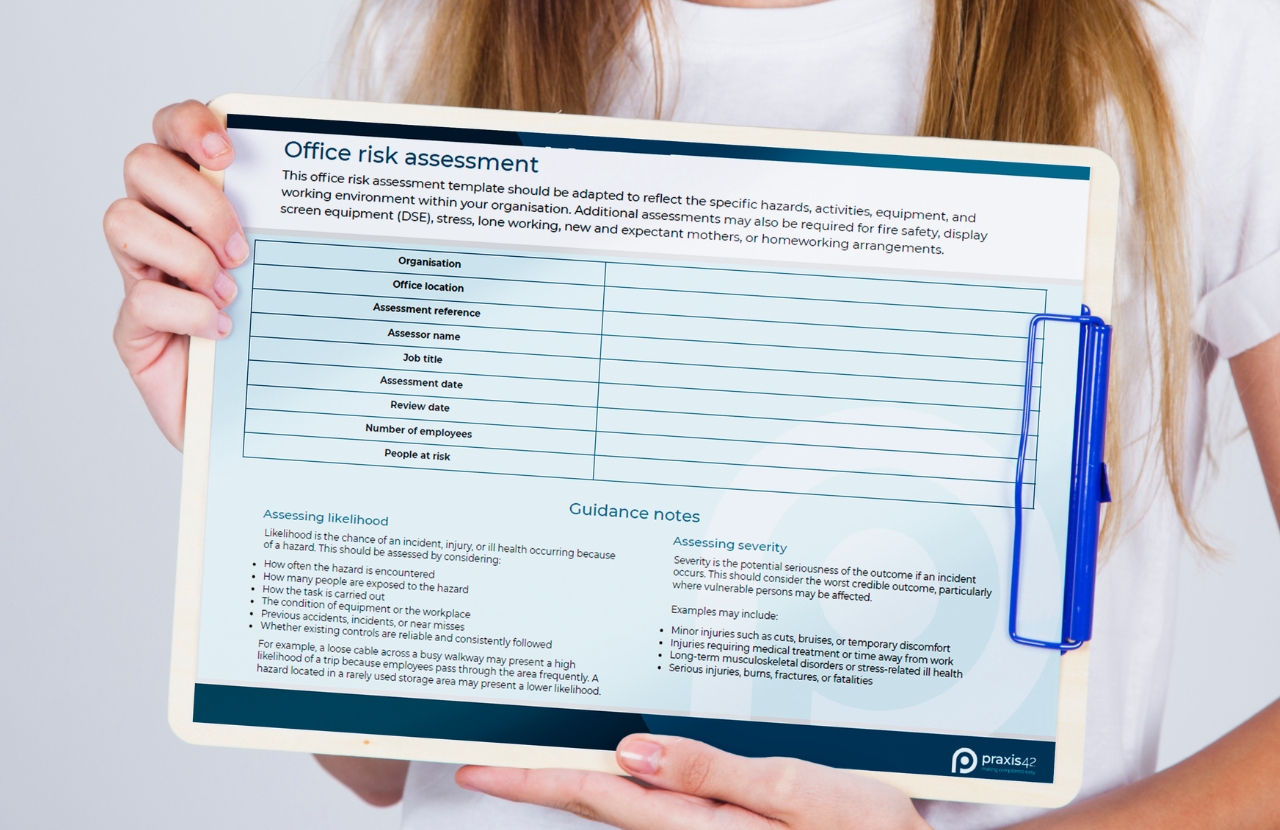
Our downloadable office risk assessment template provides a practical framework for identifying office hazards, assessing risks, recording control measures, and tracking any further actions required.
The template should be reviewed and adapted to reflect the specific hazards, activities, and working environment within your organisation. To help you complete your own office risk assessment, please download our Office Risk Assessment Sample.
Who should carry out an office hazards risk assessment?
Under the Management of Health and Safety at Work Regulations 1999, Regulation 7 employers must appoint one or more competent persons to assist them in complying with health and safety duties, including risk assessment requirements.
A competent person is someone with sufficient training, experience, knowledge, and other qualities to properly identify hazards and assess workplace risks.
This may include:
- Health and safety managers
- Facilities managers
- Office managers
- Trained supervisors or responsible persons
- External health and safety consultants
In some organisations, assessments are completed internally, while others seek office risk assessment support from health and safety consultants to ensure legal compliance.
How often should an office hazards risk assessment be reviewed?
Under the Management of Health and Safety at Work Regulations 1999, Regulation 3 employers must ensure risk assessments remain “suitable and sufficient.” This means office risk assessments should be reviewed whenever there is reason to believe the assessment is no longer valid or there has been a significant change in the matters to which it relates.
Reviews are particularly important:
- Following an accident, incident, or near miss
- After changes to office layouts or working practices
- When introducing new equipment, furniture, or processes
- If staffing arrangements or occupancy levels change significantly
- Following updates to legislation, guidance, or industry best practice
- Where existing control measures are found to be ineffective
Many organisations also review office risk assessments annually as part of their wider health and safety management arrangements. Regular reviews help ensure hazards continue to be identified and risks remain effectively controlled.
Improve workplace safety with Office Health and Safety Training
Our Office Health and Safety Training enables employees to identify hazards, prevent accidents, and work safely within an office environment.
The course covers common hazards including slips and trips, display screen equipment (DSE), stress awareness, and fire prevention as well as office hazards risk assessments, accident reporting procedures and first aid.
This training supports compliance with health and safety legislation, promoting a safer, healthier, and more productive working environment.
Find out more about Office Health and Safety Training on our website, or talk to our friendly team today on 0203 011 4242 / info@praxis42.com

Adam Clarke
Managing Director (Consulting)