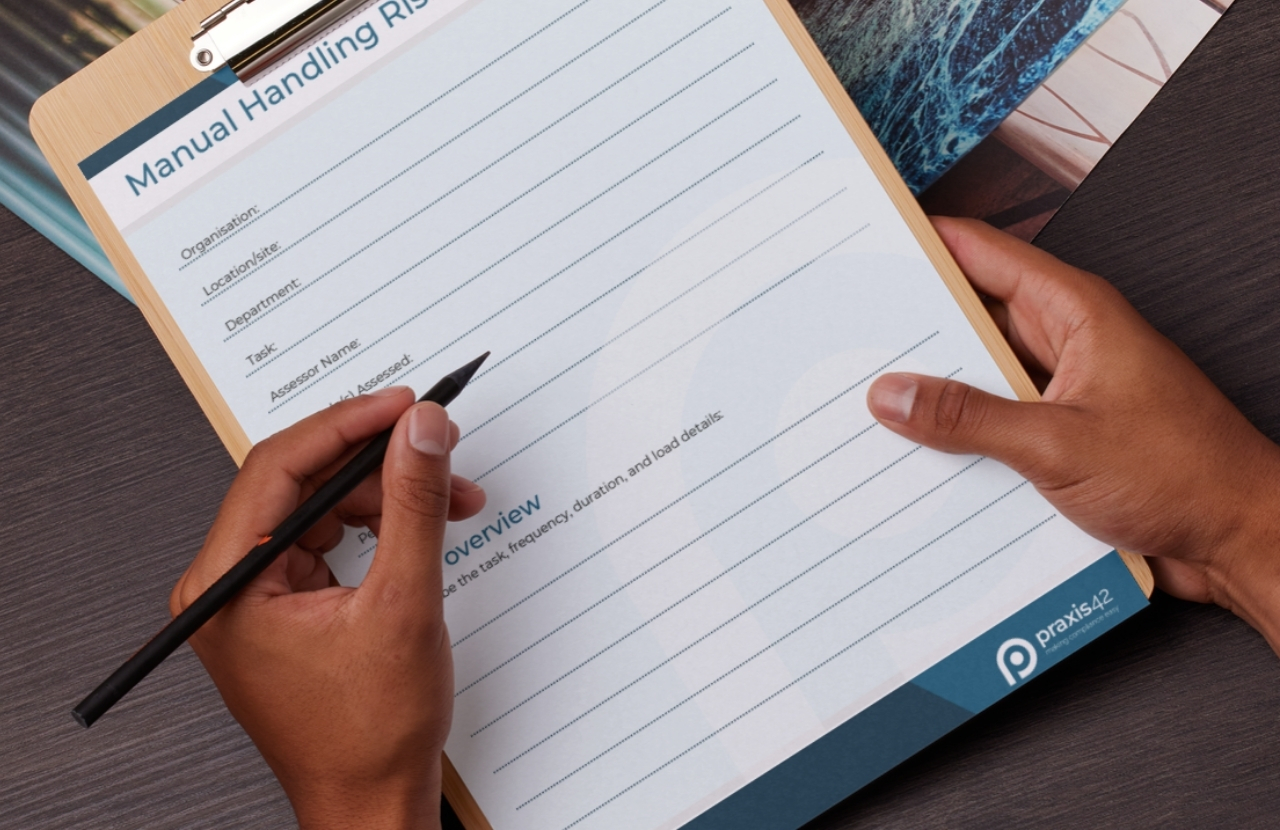

A well-structured manual handling risk assessment prevents injuries, improves safety, and demonstrates compliance. In this guide, we walk you through a manual handling risk assessment example step by step.
Download our blank Manual Handling Risk Assessment Template to customise, along with a completed Manual Handling Risk Assessment Sample so you can see what a completed risk assessment might look like.
Please note that it is very important to tailor the risk assessment to your specific tasks, working environment, and the individuals carrying out the work to ensure it is suitable and compliant.
Manual handling risk assessment example
To help you complete your own manual handling risk assessment, please download our Manual Handling Risk Assessment Sample based on a warehouse task.
In this example, the task involves lifting 10–20kg boxes from pallets to shelving in a busy warehouse environment. The assessment highlights several common risks associated with poor manual handling, including:
- Repetitive movements (High risk) due to continuous lifting throughout the shift
- Awkward postures (Medium risk) from bending and reaching
- Moderate force requirements when handling loads
- Time pressure linked to delivery targets
How risks are controlled
The sample demonstrates how existing and additional control measures are recorded:
- Existing controls such as training, PPE, and team lifting
- Additional controls including the introduction of lifting aids, task rotation, and refresher training
A manual handling risk assessment must show how risks are actively managed and reduced.
Before and after risk scoring
The example also includes a clear before and after risk assessment score:
- Initial risk score: 12 (High risk)
- After controls: 6 (Medium risk)
This demonstrates how effective control measures can significantly reduce the impact of poor manual handling.
We explain how to calculate risk in step 9, ‘Risk assessment (before and after)’, below.
Action planning and accountability
A strong manual handling risk assessment identifies risks and drives action.
The sample shows:
- Clearly defined actions (e.g. introduce lifting aids)
- Assigned responsibilities
- Deadlines and status tracking
This ensures the assessment leads to real improvements rather than being a tick-box exercise.
Monitoring and safe working practices
The final sections show how the task is reviewed and reinforced through a manual handling risk assessment checklist, including:
- Planning lifts
- Keeping loads close to the body
- Avoiding twisting
- Asking for help when needed
These simple controls are essential for preventing workplace accidents due to poor manual handling.
This checklist should be shared with the affected workers.
Complete your manual handling risk assessment
Follow the steps below to complete your manual handling risk assessment using our Manual Handling Risk Assessment Template.
1. Assessment details
Start by completing the basic information about the assessment:
- Organisation / Location / Department – where the task is taking place.
- Task / Activity – what manual handling task is being assessed.
- Assessor Name – who is carrying out the assessment.
- Job Roles Assessed – who is involved in the task.
- Dates – assessment and review date.
- People at Risk – employees, contractors, or others affected.
This ensures your risk assessment is clearly documented, easy to review, and provides a reliable record for compliance and future updates.
2. Task overview
This is where you summarise the task.
Include:
- What the task involves. Describe the specific actions being carried out (e.g. lifting, carrying, pushing, pulling) and how the task is performed.
- How often it is carried out (frequency). Identify how regularly the task is completed (e.g. occasional, hourly, continuous throughout a shift).
- How long it takes (duration). Consider how long each task lasts and the total time spent on it during a shift.
- The type and weight of loads. Include the size, shape, stability, and approximate weight of the items being handled.
For example:
“Lifting boxes weighing 10–20kg from pallets to shelving, repeated throughout a shift.”
This section sets the foundation for your manual handling risk assessment.
3. Task factors
Now assess the risks linked to the task itself. This section focuses on how the task is carried out and whether it places strain on the body.
For each question, mark:
- Yes / No – to confirm whether the risk is present.
- Risk Level (Low / Medium / High) – based on how likely it is to cause harm.
- Notes / controls – to explain the risk and record any measures already in place.
When assigning a risk level, consider both the frequency of the task and the level of strain involved.
Key things to consider:
- Is the task repetitive?
- Does it involve bending, twisting, or reaching?
- Is significant force required?
- Is there time pressure?
- Are lifts above shoulder height or below knee height?
This section helps identify common causes of manual handling injuries, particularly those linked to poor technique, repetitive strain, and awkward movements..
4. Individual factors
Next, consider the person carrying out the task.
Ask:
- Have they received training? Ask the individual and check training records.
- Do they have any health limitations? Consider any existing injuries, medical conditions, or reduced mobility that may increase risk.
- Are they experienced? Check whether they are familiar with the task or require supervision or additional support.
- Are they using appropriate PPE? Confirm suitable equipment is provided and used correctly (e.g. gloves, safety footwear).
- Do they need help (e.g. team lifting)? Identify whether the task is suitable for one person or requires assistance.
This helps ensure the task is suitable for the individual, reducing the likelihood of injury and unsafe handling.
5. Load factors
Assess the object being handled, as the characteristics of the load can significantly increase the risk of injury.
Think about:
- Weight – is the load heavy or difficult to lift safely for one person? Does it vary in weight?
- Shape – is it bulky, large, or awkward to carry, making it difficult to keep close to the body?
- Stability – is the load stable, or could it shift, move, or become unbalanced during handling?
- Grip – is it easy to hold, or does it lack handles, have smooth surfaces, or require an awkward grip?
- Hazards – does the load have sharp edges, hot or cold surfaces, or contents that could spill or cause harm?
Poor load design is a major contributor to injuries associated with poor manual handling, particularly when combined with repetition or awkward handling.
6. Environment factors
Look at the working environment.
Check:
- Is there enough space to move safely? Ensure there is sufficient room to lift, carry, and turn without obstruction or restricted movement.
- Are floors stable, dry, and free from hazards? Look for spills, loose materials, uneven surfaces, or clutter that could cause slips or trips.
- Is lighting adequate? Make sure visibility is good so loads, obstacles, and pathways can be clearly seen.
- Are there steps, slopes, or uneven surfaces? Consider how changes in level may affect balance and control while carrying loads.
- Are conditions suitable (e.g. temperature, weather)? Cold, heat, wind, or wet conditions can affect grip, stability, and concentration.
This is especially important for preventing slips, trips, and falls, which are particularly dangerous when carrying or handling loads.
7. Additional risk factors
This section captures real-world risks that may not fit neatly into other categories.
Consider:
- High workload or repetition. Tasks carried out frequently or for long periods can lead to fatigue and increase the risk of injury.
- Time pressure. Rushing or working to tight deadlines can result in poor technique and reduced attention to safety.
- Carrying loads that block vision. Obstructed sightlines can increase the risk of collisions, trips, or falls.
- One-handed lifting. Uneven load distribution can place additional strain on the body and reduce control.
- Sudden or jerky movements. Unexpected movements can increase the risk of strains, sprains, or loss of balance.
- Poor or unsuitable equipment. Faulty, missing, or inappropriate equipment can make tasks more difficult and unsafe.
This helps build a more complete manual handling risk assessment checklist.
8. Control measures
Now document how risks are managed. This section shows what is already in place to control risks and what further action is needed to reduce them.
Existing controls
What measures are currently in place to manage the risks?
- Training – employees have received manual handling training and understand safe techniques.
- PPE – appropriate personal protective equipment is provided and used (e.g. gloves, safety footwear).
- Equipment – mechanical aids such as trolleys, hoists, or pallet trucks are available and in use.
- Safe systems of work – established procedures are followed to carry out tasks safely.
Additional controls
What improvements are needed to further reduce risk?
- Introduce lifting aids. Provide equipment to minimise manual handling where possible.
- Redesign tasks. Adjust how the task is carried out to reduce strain (e.g. change layout or workflow).
- Reduce load weight. Break loads into smaller, more manageable sizes.
- Provide refresher training. Reinforce safe practices and address any gaps in knowledge.
9. Risk assessment (before and after)
Evaluate the level of risk by considering how likely an injury is and how serious it could be.
- Likelihood (1–5) – How likely is it that someone could be injured?
(e.g. 1 = very unlikely, 5 = very likely)
- Severity (1–5) – How serious would the injury be if it happened?
(e.g. 1 = minor injury, 5 = serious or life-changing injury)
To calculate the risk:
Risk Score = Likelihood × Severity
For example, a task with a likelihood of 4 and severity of 3 would give a risk score of 12, which indicates a higher level of risk that needs action.
Once you have identified and implemented control measures, reassess the task and calculate a new score. The aim is to reduce the likelihood (or severity) so the overall risk level is lower.
This before-and-after comparison clearly shows whether your controls are effective and helps demonstrate how your manual handling risk assessment reduces risk in practice.
10. Action plan
This section turns your findings into clear, practical steps to improve safety.
Record what needs to happen next:
- What action is required. Clearly describe what needs to be done to reduce the risk (e.g. introduce lifting aids, provide training).
- Priority level. Indicate how urgent the action is based on the level of risk (e.g. high, medium, low).
- Who is responsible. Assign a specific person to ensure the action is completed.
- Deadline. Set a realistic timeframe for completion.
- Status. Track progress (e.g. open, in progress, completed).
This helps ensure actions are clearly communicated, followed through, and reviewed, leading to meaningful and measurable improvements in workplace safety.
11. Monitoring and review
A manual handling risk assessment should be regularly reviewed to ensure it remains accurate and effective.
Check:
- Are controls working? Confirm that the measures you’ve put in place are reducing risk and being followed in practice.
- Have there been incidents? Review any accidents, near misses, or feedback to identify whether further improvements are needed.
- Has the task changed? Consider whether changes to equipment, processes, workload, or environment may introduce new risks.
Regular reviews help keep your assessment up to date, ensure ongoing compliance, and support continuous improvement in workplace safety.
12. Sign-off
The assessment should be formally signed off by a responsible person to confirm it is complete and accurate.
The responsible person is someone with the authority and competence to review the assessment, such as a manager, supervisor, or health and safety consultant. They should understand the task, the risks involved, and the control measures in place.
13. Safe handling checklist
The manual handling checklist at the end of the risk assessment is to give to employees as a quick reference guide to safe manual handling practices. Like all the other elements of the risk assessment it should be tailored specifically to the employee and their role.
- Plan the lift. Assess the load and route in advance to avoid unnecessary risks
- Keep the load close. Holding items close to the body reduces strain on the back and improves control
- Bend knees, not the back. Use the legs to lift, helping to protect the spine
- Avoid twisting. Turn using your feet rather than twisting your torso while carrying a load
- Use aids where possible. Make use of trolleys, hoists, or other equipment to reduce manual effort
- Ask for help. Use team lifting when loads are too heavy or awkward for one person
- Take breaks. Regular rest helps prevent fatigue and reduces the risk of injury over time
This checklist supports consistent safe behaviour and helps reduce the risk of injury during everyday manual handling activities. It is also a helpful reference when it is time to review your risk assessment.
Need support with your manual handling risk assessment?
If you’ve worked through our manual handling risk assessment example but want to be confident your assessment is accurate, tailored, and fully compliant with health and safety law, our experienced consultants can help.
We provide practical, bespoke manual handling risk assessments designed around your specific tasks, environments, and workforce, helping you reduce risk, prevent injuries, and meet your legal duties under the Manual Handling Operations Regulations 1992 (MHOR).
Speak to our friendly team today to arrange your manual handling risk assessment: 0203 011 4242 / [email protected]

Adam Clarke
Managing Director (Consulting)