
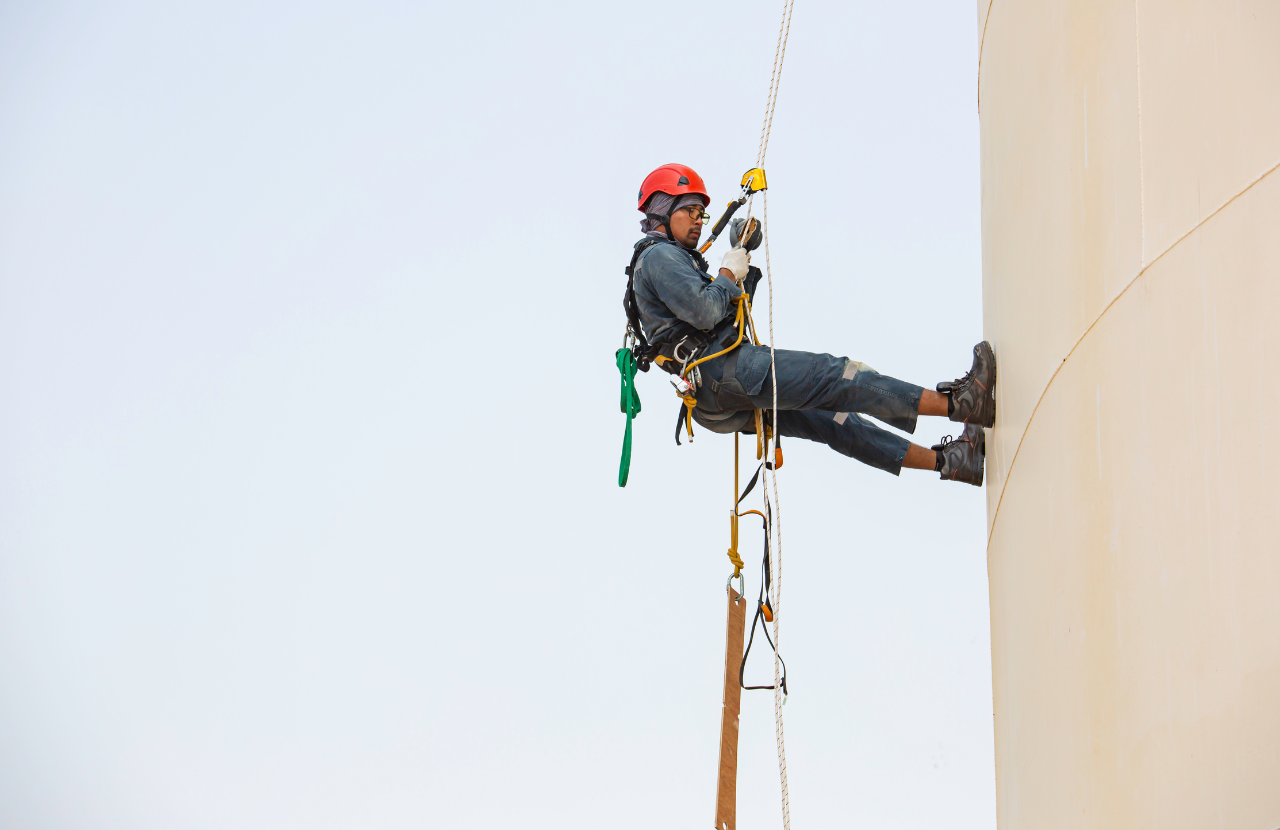

While Great Britain has a strong workplace safety record, falls from height remain the most common cause of fatal workplace accidents. Health and Safety Executive (HSE) figures show that 31 workers died following a fall from height in 2025/26, accounting for around a quarter of all worker fatalities.
Working at height specialists can help organisations prevent falls, protect employees and contractors and comply with the Work at Height Regulations 2005. A work at height specialist can assess risks, identify effective precautions and provide expert support for complex or higher-risk activities.
What is working at height?
Under the Work at Height Regulations 2005, work at height is work where a person could fall far enough to cause personal injury. This includes work at or below ground level and accessing or leaving such a place, except by a permanent staircase. There is no minimum height.
Examples include:
- Working near an open edge or floor opening. Someone working at ground or floor level could fall to a lower level through an opening or over an unprotected edge.
- Working near an excavation or hole. Work at ground level can be work at height where there is a risk of falling into an excavation, pit or other opening.
- Using ladders and stepladders. Even a relatively short fall can cause injury, so equipment must be suitable for the task and used safely.
- Working on roofs or near fragile surfaces and skylights. There may be a risk of falling from an edge or through a surface that cannot safely support a person’s weight.
- Working on scaffolding or mobile access towers. Suitable platforms and fall prevention measures are needed to provide a safe place of work.
- Using mobile elevating work platforms (MEWPs). Equipment such as cherry pickers and scissor lifts must be suitable for the task and used by competent people (those with the skills, knowledge, training and experience to use the equipment safely).
What are the legal requirements for working at height?
The Work at Height Regulations 2005 require employers and those who control work at height to ensure it is properly planned, appropriately supervised and carried out by competent people.
Planning must follow the work at height hierarchy. This sets out the order in which risks should be controlled, starting with avoiding work at height wherever reasonably practicable, then preventing falls and, where a fall cannot be prevented, minimising the distance and consequences.
1. Avoid working at height
Work at height should be avoided where it is reasonably practicable. Consider whether the task can be completed safely from ground level, for example by using extendable equipment or lowering equipment to the ground for maintenance.
The Work at Height Regulations 2005, Regulation 6 state that employers must ensure work is not carried out at height where it is “reasonably practicable to carry out the work safely otherwise than at height.”
HSE guidance recommends doing as much work as possible from the ground, such as using extendable tools, installing equipment at ground level or lowering equipment for maintenance.
2. Prevent falls
Where work at height cannot be avoided, suitable and sufficient measures must be taken to prevent falls.
Where reasonably practicable, work should be carried out from a place that is already safe, such as a roof with permanent guardrails. Where this is not possible, suitable work equipment should be provided, such as scaffolding, a MEWP or a properly guarded working platform.
Regulation 6 requires employers to take “suitable and sufficient measures to prevent, so far as is reasonably practicable, any person falling a distance liable to cause personal injury.”
HSE guidance explains that this could mean using an existing safe place, such as a roof with permanent perimeter guardrails, or suitable equipment such as scaffolding, tower scaffolds or MEWPs.
Collective protection measures, such as guardrails, should take priority over personal protection measures, such as safety harnesses. Collective measures protect everyone working in the area without requiring individuals to use or wear equipment, while personal protection only protects the person using it and relies on correct use.
Anyone carrying out work at height must also have the skills, knowledge and experience needed to work safely. Suitable Work at Height Training can help employees understand the risks, precautions and correct use of equipment for the tasks they carry out.
3. Minimise the distance and consequences of a fall
Where the risk of falling cannot be prevented, measures must be taken to minimise the distance and consequences of a fall. Depending on the work, this could include safety nets, soft-landing systems or personal fall arrest equipment.
Regulation 6 requires employers, where the risk remains, to provide sufficient work equipment to minimise “the distance and consequences” of a fall or, where minimising the distance is not reasonably practicable, its consequences.
HSE guidance gives safety nets and soft-landing systems as examples of collective protection and fall arrest and industrial rope access systems as examples of personal protection.
Personal fall protection must be suitable for the task and users must have appropriate training. Where fall arrest equipment is used, arrangements should also consider how someone would be rescued following a fall.
All equipment used for work at height must be suitable for the task and appropriately inspected and maintained.
When should you use working at height specialists?
Working at height specialists can provide valuable support when work is complex or higher risk, or when additional expertise is needed to plan and manage the work safely.
Competence is a legal requirement. Regulation 5 of the Work at Height Regulations 2005 requires anyone involved in organising, planning, supervising or carrying out work at height to be competent, or supervised by a competent person if they are being trained.
Depending on the circumstances, specialists can carry out or review risk assessments, advise on suitable controls and equipment, develop safe systems of work and RAMS (risk assessments and method statements), review contractor arrangements and help plan for emergencies.
Specialist support is particularly valuable in these circumstances:
Complex or higher-risk work
Some activities require more detailed assessment and planning because of the nature of the work or the potential consequences of a fall. Examples include difficult access, significant fall distances, multiple hazards or work in unusual conditions.
A specialist can consider how these factors interact and develop a suitable approach to the work. This may include a detailed risk assessment and safe system of work or RAMS covering access and egress, equipment, fall protection, supervision, weather conditions and emergency arrangements.
Limited in-house expertise
An organisation may have sufficient competence to manage routine work at height but need additional expertise for unfamiliar or technically complex activities.
A specialist can supplement existing knowledge with experience of similar work, helping to interpret legal requirements, assess less familiar risks and make informed decisions about how the work should be planned and managed.
Selecting access and fall protection equipment
Where there are several ways to access or carry out work at height, specialist advice can help determine which equipment is suitable for the task.
This involves considering the findings of the risk assessment alongside factors such as the nature and duration of the work, access, ground conditions, available space and weather. Specialists can then advise on suitable access and fall protection equipment in accordance with the work at height hierarchy.
Working on fragile surfaces
Fragile roofs, rooflights, skylights and other surfaces that may not safely support a person’s weight require specific expertise because a person could fall through the surface as well as from an edge.
A specialist can identify fragile areas, assess the condition and layout of the working area and develop safe access and working arrangements appropriate to the site and task.
Managing contractors
Organisations need suitable arrangements for managing contractors carrying out work at height on their premises. Specialist support can help assess contractor competence and review proposed risk assessments and method statements (RAMS) to determine whether they adequately address the work and site conditions.
Specialists can also support coordination where several contractors are involved, or their activities could affect employees, visitors or other site users. Where the Construction (Design and Management) Regulations 2015 apply, additional duties may apply depending on the organisation’s role.
Planning emergency and rescue arrangements
Some work at height requires more detailed rescue planning, particularly where fall arrest equipment or rope access is used, or where someone could become suspended or stranded in a difficult-to-reach location.
Working at height specialists can develop practical rescue procedures setting out how a person will be reached and recovered, the equipment required and who needs the necessary competence and training to carry out the rescue.
Following an incident or near miss
An accident or near miss can provide important information about the effectiveness of existing arrangements. An independent specialist can investigate or review what happened and identify any underlying issues with the way the work was planned or carried out.
This can help identify practical improvements to risk assessments, working procedures, equipment, training or supervision and reduce the likelihood of a similar incident occurring again.
Changes to work or the workplace
Changes to premises, equipment, processes or working methods can introduce risks that have not previously been assessed. Specialist involvement at an early stage can help ensure work at height is considered before new arrangements are introduced.
This can be particularly valuable when installing or changing roof access systems, fixed ladders, anchor points or access to plant and equipment at height.
Temporary or non-routine work
One-off or infrequent activities can require additional expertise because existing procedures may not cover the task or employees may have limited experience of carrying it out.
For maintenance, installation, inspection or repair work, a specialist can assess the specific activity and develop task-specific arrangements, including risk assessments, RAMS or safe systems of work where required.
Reviewing existing arrangements
Periodic specialist review can provide assurance that work at height continues to be managed effectively, rather than waiting for an incident or significant change to identify areas for improvement.
A specialist can review risk assessments, safe systems of work, equipment, inspection arrangements, training and working practices to identify gaps and recommend proportionate improvements.
Supporting major projects or multiple sites
Large projects and multi-site organisations can involve different activities, contractors and working environments, making consistency particularly important.
Working at height specialists can provide oversight across sites or projects, establish common standards and review higher-risk activities to support a consistent approach to risk assessment, contractor management and safe working practices.
What qualifications should a work at height specialist have?
A competent work at height specialist will have the right combination of knowledge, skills, training and experience for the work they are advising on.
When appointing a specialist, consider their:
- Health and safety knowledge and qualifications. They should have a thorough understanding of risk assessment, hazard identification and risk control. Qualifications such as the NEBOSH National General Certificate or NEBOSH Health and Safety Management for Construction can provide evidence of broader health and safety competence.
- Specialist training. Training should reflect the equipment and activities they are advising on. This could include IPAF training for MEWPs, PASMA training for mobile access towers or IRATA qualifications for industrial rope access, as well as training in areas such as scaffolding or fall protection systems.
- Practical experience of similar work. They should have experience applying work at height controls in practice, particularly for activities comparable to those they will be advising on. This helps demonstrate that they can assess real working conditions and identify practical, proportionate solutions.
- Knowledge of legislation and industry guidance. They should have a thorough understanding of the Work at Height Regulations 2005, applicable HSE guidance and recognised industry standards. Importantly, they should be able to interpret and apply these requirements to specific activities and working environments.
- Experience within your sector or working environment. Experience in comparable workplaces can help a specialist understand factors that may affect how work is planned and carried out, such as sector-specific hazards, access restrictions, operational requirements and other activities taking place nearby.
Qualifications and training should always be considered alongside the specialist’s knowledge, skills and practical experience.
Can our working at height specialists help you?
Our working at height specialists can provide competent advice to help you identify hazards, assess existing arrangements and establish proportionate controls based on your workplace and activities.
We can also support your organisation with work at height risk assessments, RAMS and safe systems of work, contractor management and training, helping you protect employees and contractors while meeting your legal responsibilities.
Please contact our friendly team to discuss your work at height requirements on 0203 011 4242 / [email protected]

Adam Clarke
Managing Director (Consulting)