


Understanding the difference between accident and incident is essential for improving workplace safety, strengthening reporting procedures, and preventing serious harm.
In this guide, we explain the meaning of accidents and incidents in health and safety, explore near misses and unsafe conditions, detail reporting and RIDDOR requirements, and examine how effective investigation and risk management help reduce the likelihood of future harm.
What is an incident in health and safety?
In health and safety terms, an incident is any unplanned or uncontrolled event that has the potential to cause injury, ill health, or damage, even if no harm occurs.
The Health and Safety Executive (HSE) describe incidents as undesired circumstances and near misses that could cause accidents.
An incident can include:
- Near misses – events where no injury occurs but could have
- Unsafe acts or conditions – behaviours or environments that increase risk
- Minor events – situations that have the potential to escalate
An incident is an early warning. It highlights where controls may be weak or failing and provides an opportunity to carry out risk assessment, identify root causes, and take preventative action before an accident occurs.
The accident: when potential becomes reality
An accident is where harm has occurred. This could involve:
- Injury to a person – for example, a worker slipping on a wet floor and breaking a wrist, or straining their back while lifting incorrectly
- Work-related ill health – such as developing dermatitis from repeated exposure to chemicals, or hearing damage from prolonged noise exposure
- Damage to property or equipment that creates risk – for instance, a forklift striking racking and causing instability, or machinery failure leading to a risk of injury
Key differences: accident vs incident comparison
| Term | Definition | Outcome |
|---|---|---|
| Incident | Unplanned event with potential to cause harm | May or may not result in harm |
| Accident | Unplanned event that results in harm | Injury, illness, or damage occurs |
What is a near miss?
A near miss is a type of incident where no harm occurs, but the potential for harm was present.
For example:
- A loose handrail is spotted before someone leans on it
- A forklift reverses without seeing a pedestrian, who steps back just in time
- Incorrect labelling on a chemical is noticed before use
- A load shifts during lifting but is stabilised before it falls
- An electrical cable with damaged insulation is identified before use
Near misses are critical for identifying hazards and improving preventative measures. They often reveal weaknesses in existing control measures and highlight where further action is needed to reduce risk.
Incident vs accident – examples
These examples highlight the difference between an accident and incident.
Incident examples (no harm but potential was present):
- Near misses – events where no injury occurs but could have
- A forklift reverses and a pedestrian steps back just in time
- A slip that doesn’t result in a fall
- Unsafe acts or conditions – behaviours or environments that increase risk
- A guard is missing from machinery but identified before use
- A delivery blocks a fire exit and is moved before an emergency occurs
- Minor events with potential to escalate – situations that could lead to harm if not addressed
- A chemical container leaks but is contained quickly
- A strong solvent smell highlights poor ventilation before exposure causes harm
- A loose handrail is identified before it fails
Accident examples (harm or damage has occurred):
- A worker slips and breaks a wrist
- Exposure to a hazardous substance causes illness
- Equipment failure leads to injury or creates an immediate risk to people
- A manual handling task results in a back injury
- Contact with unguarded machinery causes cuts or amputation
- Prolonged exposure to noise leads to hearing damage
Understanding the difference between accident and incident helps organisations report events consistently, identify hazards earlier, and take preventative action before more serious harm occurs.
Why the difference matters in practice
Understanding the difference between accident and incidents is essential for managing workplace risk effectively.
The safety triangle (Heinrich’s Pyramid)
Health and safety theory suggests that for every serious accident, there are many more minor incidents and near misses. This relationship is often illustrated by Heinrich’s Pyramid (also known as the safety triangle):
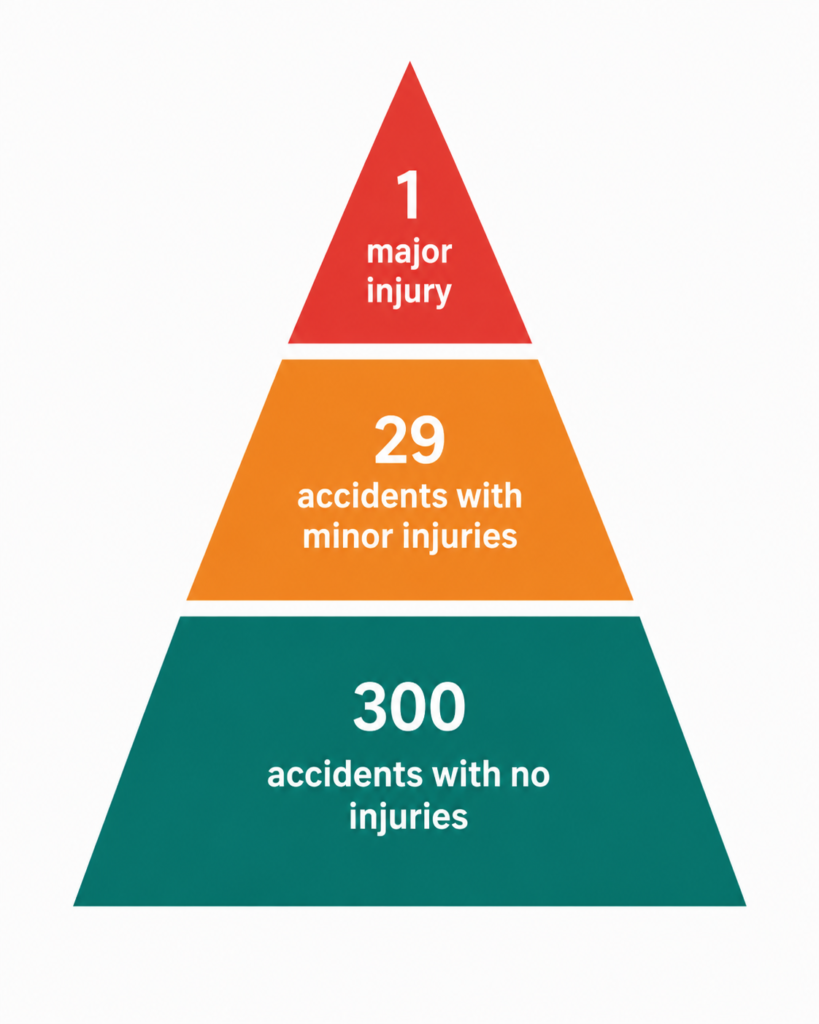
Heinrich’s theory suggests that serious accidents are not random, but a result of repeated unsafe conditions and behaviours over time. By identifying and addressing the smaller, more frequent incidents at the base of the pyramid, organisations can prevent more serious harm at the top.
This is why organisations should:
- Investigate incidents, not just accidents
Near misses provide early insight into hazards before harm occurs. - Carry out root cause analysis early
Understanding why an incident happened helps prevent escalation. - Implement mitigation and control measures
Strengthening controls reduces the likelihood of future accidents.
Focusing only on accidents means missing opportunities to act on early warning signs. By identifying and addressing incidents, organisations can take a proactive approach and prevent harm before it occurs.
Reporting incidents and accidents
Organisations should have a system for reporting and recording incidents and accidents internally, including near misses and unsafe conditions. Employers with 10 or more employees must keep a written accident record in an accident book or equivalent system.
While not all employers are legally required to keep formal accident records, doing so supports duties under the Health and Safety at Work etc. Act 1974 and the Management of Health and Safety at Work Regulations 1999, Regulation 3 to manage risks and take preventive action.
Keeping records of incidents and accidents provides a clear account of what has happened, supports investigation, and helps identify patterns or recurring risks before they lead to more serious harm
This involves:
- Reporting incidents through internal procedures
Ensure employees know how and when to report incidents, near misses, and unsafe conditions, using a consistent and accessible system. - Recording key details
Capture what happened, when and where it occurred, who was involved, and any immediate actions taken. Clear records support follow-up and accountability. - Investigating causes
Look beyond the immediate event to identify root causes, such as unsafe conditions, human factors, or gaps in procedures. - Reviewing and updating controls
Use findings to update risk assessments, improve control measures, and prevent recurrence. This may include changes to processes, training, or supervision.
RIDDOR reporting requirements
Under RIDDOR Regulation 4 and RIDDOR Regulation 6, employers must report specific work-related events to the Health and Safety Executive.
These include:
- Fatalities and specified serious injuries (such as fractures or amputations)
- Injuries that result in an employee being unable to work for more than seven consecutive days
- Certain diagnosed occupational diseases linked to workplace exposure
- Dangerous occurrences, such as structural failures, lifting equipment collapse, or fires
Reports must be submitted within set timeframes using the HSE reporting system. For more information, please read our article, What is RIDDOR and why is RIDDOR reporting important?
Should you report an incident if no one was hurt?
Incidents where no one is injured should still be reported and recorded internally.
As highlighted by Heinrich’s Pyramid, serious accidents are often preceded by many minor incidents and near misses. Addressing these early warning signs at the base of the pyramid helps prevent more serious harm at the top.
Reporting these incidents helps organisations identify hazards early, understand root causes, and improve control measures before harm occurs. It also highlights patterns and recurring risks, supporting a more proactive approach to managing health and safety.
Strengthen risk management with incident reporting software
Our incident reporting software helps organisations streamline the reporting, tracking, investigation, and management of workplace incidents, near misses, and unsafe conditions in one central system.
Designed to support proactive health and safety management, the platform makes it easier to record incidents consistently, monitor trends, improve corrective actions, and maintain clear audit trails for compliance and internal reporting.
Find out how our incident reporting software can help your organisation improve visibility, strengthen risk management, and create a safer working environment.
Talk to our friendly team today on 0203 011 4242 / [email protected]

Adam Clarke
Managing Director (Consulting)