
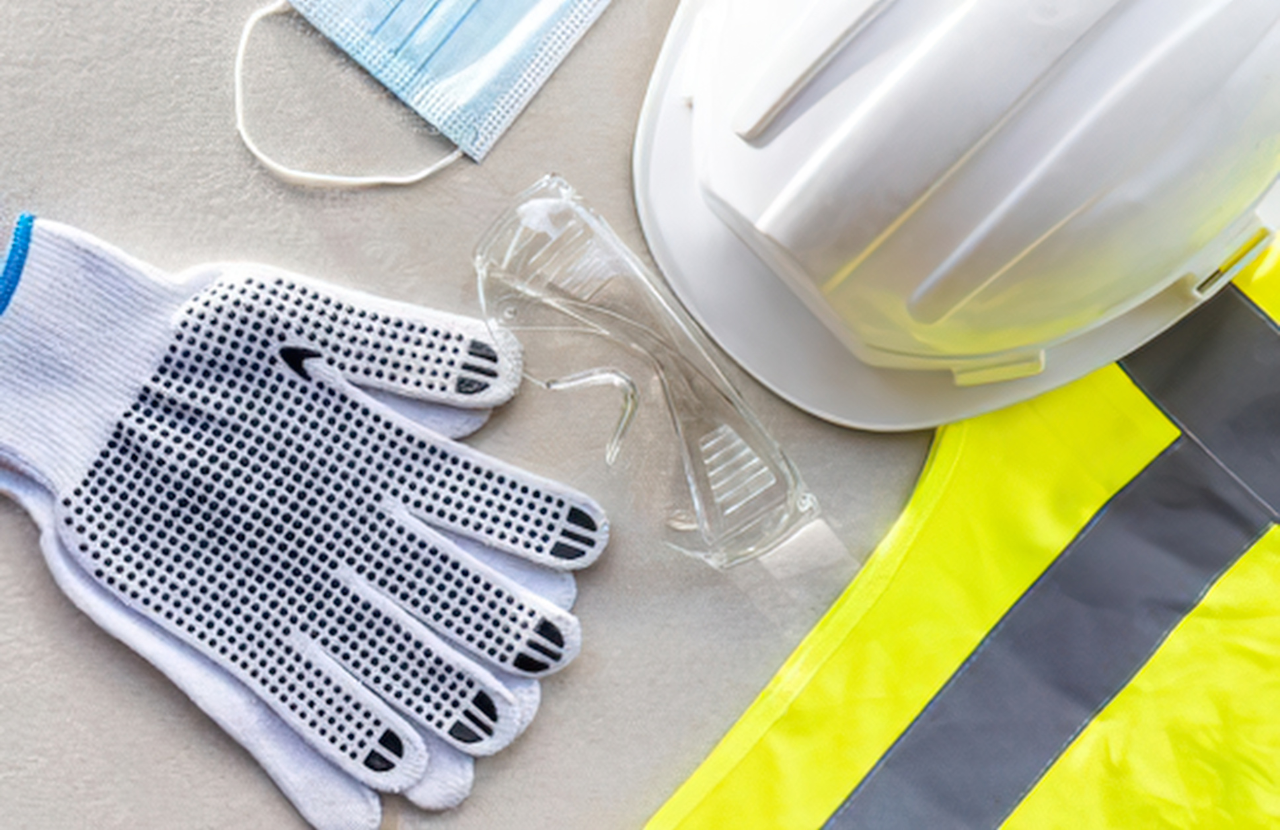

In this guide we explain the different types of personal protective equipment (PPE), the legal requirements surrounding PPE, and the responsibilities employers and employees have for ensuring PPE provides effective protection.
We also discuss how PPE should be selected, maintained, inspected, and used correctly, the standards that apply, and the practical steps organisations can take to reduce the risk of injury and ill health.
What does PPE stand for in health and safety?
PPE stands for ‘personal protective equipment’. It refers to any equipment, clothing, or protective device worn by workers to reduce risks to their health and safety at work.
Why is PPE considered the last line of defence?
Under UK health and safety law, PPE items should only be used where risks cannot be adequately controlled by other measures. This is because personal protective clothing and equipment reduces exposure to hazards but does not eliminate the hazard itself.
The Personal Protective Equipment at Work Regulations 1992, Regulation 4 requires employers to prioritise other controls before relying on PPE.
Plus, the Management of Health and Safety at Work Regulations 1999, Schedule 1 requires collective protective measures to take priority over individual protective measures such as PPE. Collective protective measures are controls that protect multiple people at once, such as guard rails, extraction systems, barriers, or machine guarding, rather than relying on individual workers wearing PPE.
Employers should follow the hierarchy of controls, a risk management framework that prioritises the most effective ways of reducing workplace risks, in the following order:
- Elimination – physically remove the hazard entirely, such as designing out a dangerous process
- Substitution – replace the hazard with a safer alternative, such as using a less hazardous chemical
- Engineering controls – isolate workers from the hazard through measures such as machine guarding, extraction systems, or barriers
- Administrative controls – reduce exposure through safe systems of work, training, supervision, signage, and procedures
- PPE – protect the worker with personal protective equipment such as gloves, helmets, or respirators
As health and safety protective equipment depends on correct fit, maintenance, and user behaviour, it is generally less reliable than higher-level controls.
What are employers’ legal duties under PPE health and safety regulations?
Several pieces of health and safety legislation place duties on employers to assess risks, provide suitable types of PPE, and protect workers from harm.
Personal Protective Equipment at Work Regulations 1992
The Personal Protective Equipment at Work Regulations 1992 cover core legal duties relating to workplace personal protective equipment.
Key duties include:
- Employers must provide suitable PPE where risks cannot be adequately controlled by other means – Regulation 4
- PPE must be compatible where more than one item is worn together – Regulation 5
- PPE must be properly assessed before use – Regulation 6
- PPE must be maintained, cleaned, repaired, or replaced as appropriate – Regulation 7
- Employees must receive adequate information, instruction, and training – Regulation 9
- PPE must be used correctly – Regulation 10
Personal Protective Equipment at Work (Amendment) Regulations 2022
The Personal Protective Equipment at Work (Amendment) Regulations 2022 expanded PPE duties beyond traditional employees to include many “limb (b) workers”, such as some temporary workers, agency staff, and gig economy workers.
This amendment strengthened protections for workers who may not have standard employee status but are still exposed to workplace risks.
Health and Safety at Work etc. Act 1974
The Health and Safety at Work etc. Act 1974, Section 2 requires employers to protect the health, safety, and welfare of employees, including providing suitable personal protective devices where necessary. In addition, Section 9 prevents employers from charging workers for PPE provided for health and safety purposes.
Management of Health and Safety at Work Regulations 1999
Under Regulation 4 and Schedule 1 of the Management of Health and Safety at Work Regulations 1999, employers must prioritise collective protective measures (guard rails, extraction systems, barriers, machine guarding etc.) over individual protective measures such as PPE.
Control of Substances Hazardous to Health (COSHH) Regulations 2002
The COSHH Regulations 2002 place duties on employers to assess and control exposure to hazardous substances.
Where risks remain, suitable PPE and respiratory protective equipment (RPE) may be required. Regulation 9 requires certain control measures, including some forms of RPE, to be thoroughly examined and tested at suitable intervals to ensure they remain effective.
Construction (Design and Management) Regulations 2015
The Construction (Design and Management) Regulations 2015, Schedule 2 requires suitable protective measures on construction sites where risks remain after other controls have been applied. This includes PPE such as hard hats, eye protection, high-visibility clothing, gloves, and fall protection equipment.
Control of Noise at Work Regulations 2005
The Control of Noise at Work Regulations 2005, Regulation 7 requires employers to provide suitable hearing protection where noise exposure exceeds legal action levels. Employers must also ensure hearing protection is properly used within designated hearing protection zones.
Work at Height Regulations 2005
Where fall protection PPE such as harnesses, lanyards, and fall arrest systems are used, the Work at Height Regulations 2005, Regulation 12 requires work equipment exposed to conditions causing deterioration to be inspected at suitable intervals and after exceptional circumstances that could affect safety.
What are the different types of personal protective equipment?
Here is a list of PPE safety equipment, but the specific PPE required depends on the hazards identified during a workplace risk assessment.
| PPE category | Types of personal protective clothing and equipment – examples | Primary hazard protected | Standard reference |
| Head protection | Hard hats, bump caps, industrial safety helmets, electrical safety helmets | Falling objects, impact | BS EN 397:2012+A1:2012 for industrial safety helmets BS EN 812:2012 for bump caps. |
| Eye & face protection | Safety glasses, safety goggles, face shields, welding visors, full-face visors | Flying debris, chemicals, radiation | BS EN ISO 16321-1:2022+A1:2025. |
| Hearing protection | Earplugs, ear defenders, canal caps | Excessive workplace noise | BS EN 352 series. Use the relevant part, e.g. BS EN 352-1:2020 for earmuffs, BS EN 352-3:2020 for helmet-mounted earmuffs. |
| Respiratory protection (RPE) | Full-face respirators, disposable filtering facepiece masks, half-mask respirators, powered respirators | Dust, fumes, gases, vapours | BS EN 149:2001+A1:2009 for filtering half masks BS EN 140:1999 for half/quarter masks BS EN 136:1998 for full-face masks. |
| Hand & arm protection | Chemical-resistant or cut-resistant gloves, disposable gloves, heat-resistant gloves, anti-vibration gloves | Cuts, chemicals, micro-organisms | BS EN 388:2016+A1:2018 for mechanical risks BS EN ISO 374-1:2016+A1:2018 for chemical risks BS EN ISO 374-5:2016 for micro-organisms. |
| Foot & leg protection | Safety boots, slip-resistant footwear, steel toe cap footwear, protective wellington boots, metatarsal protection | Crushing, slips, punctures | BS EN ISO 20345:2022+A1:2024 for safety footwear. |
| Body protection | High-visibility clothing, chemical protective suits, flame-resistant clothing, coveralls, aprons, disposable protective clothing | Visibility, contamination, heat | BS EN ISO 20471:2013+A1:2016 for high-vis clothing BS EN 14605:2005+A1:2009 for liquid chemical protective clothing BS EN ISO 11612:2015 for heat and flame. |
| Fall protection | Full body harnesses, lanyards, fall arrest systems, energy absorbers, anchor points | Falls from height | BS EN 361:2002 for full body harnesses BS EN 354:2010 for lanyards BS EN 355:2002 for energy absorbers BS EN 363:2018 for personal fall protection systems. |
Head protection
Head protection is used where there is a risk of injury from falling objects, swinging loads, impact with fixed structures, or accidental head contact with machinery and equipment. It should be suitable for the specific hazard and adjusted correctly to ensure effective protection.
Damaged helmets should be replaced immediately, and many manufacturers specify maximum service lifespans even where no visible damage is present.
Eye and face protection
Eye and face protection helps protect workers from hazards such as flying particles, dust, chemical splashes, molten metal, sparks, intense light, and optical radiation.
Different types of eye protection provide different levels of protection. For example, safety glasses may protect against low-level impact hazards, while sealed goggles may be required for chemical handling or dusty environments.
Eye protection should fit correctly and remain compatible with other PPE such as respiratory protection or safety helmets.
Hearing protection
Hearing protection is required where workplace noise exposure exceeds legal action levels under the Control of Noise at Work Regulations.
The main thresholds are:
- 80 dB(A) – Lower exposure action value where employers must provide hearing protection and information
- 85 dB(A) – Upper exposure action value where hearing protection becomes mandatory
Employers should also attempt to reduce noise exposure through engineering and administrative controls before relying solely on PPE.
Respiratory protective equipment (RPE)
Respiratory protective equipment protects workers from inhaling harmful airborne substances such as dust, fumes, gases, vapours, and biological contaminants.
Where tight-fitting respirators are used, face fit testing is a legal requirement under COSHH Regulations 2002 and must be carried out by a competent person. A poor-fitting respirator may allow contaminated air to bypass the seal, significantly reducing protection.
Hand and arm protection
Hand and arm protection helps reduce injuries caused by cuts, chemicals, burns, abrasion, vibration, biological agents, and extreme temperatures.
No single glove protects against every hazard, so gloves should be selected according to the specific risks identified in the workplace. Employers should also consider dexterity, grip, comfort, and compatibility with other PPE when selecting protective gloves.
Damaged or contaminated gloves should be replaced promptly to maintain protection.
Foot and leg protection
Foot and leg protection is used where workers may be exposed to crushing injuries, punctures, slips, falling objects, sharp materials, or hazardous substances.
Different types of safety footwear provide different forms of protection, including penetration-resistant midsoles, anti-static properties, chemical resistance, and ankle support.
Footwear should be suitable for the working environment and maintained in good condition to ensure ongoing protection.
Body protection
Body protection includes protective clothing to shield workers from contamination, heat, flames, chemicals, weather conditions, and visibility risks.
High-visibility clothing is often required where workers operate near vehicles or moving plant, while chemical suits and flame-resistant clothing may be necessary in higher-risk industrial environments.
Protective clothing should fit correctly, remain compatible with other PPE, and be replaced if damaged or contaminated.
Fall protection
Fall protection equipment is used where workers are at risk of falling from height and the risk cannot be adequately controlled by other measures.
Fall protection equipment must be properly selected, fitted, and inspected before use. Many items also require formal periodic inspections by a competent person.
Workers using fall arrest equipment should receive suitable training to ensure equipment is used safely and correctly.
How often should PPE be inspected and replaced?
Under the Personal Protective Equipment at Work Regulations 1992, Regulation 7, employers must ensure safety PPE is properly maintained, cleaned, repaired, or replaced so it remains effective and in good working order. Formal inspections should be carried out at suitable intervals by a competent person, following manufacturer guidance and workplace procedures.
Employees also have duties under Regulation 10 to use PPE correctly and take reasonable care of the equipment provided, which is why workers should check PPE before use for signs of wear, damage, contamination, or deterioration.
Can employees refuse to wear PPE?
Employees have legal responsibilities under Section 7 of the Health and Safety at Work etc. Act 1974 to take reasonable care of themselves and others.
Where a risk assessment identifies safety personal protective equipment as necessary, workers must:
- Wear PPE correctly – PPE should be worn and adjusted in accordance with the manufacturer’s instructions and any training provided by the employer. Incorrectly fitted or improperly worn PPE may significantly reduce the level of protection provided.
- Follow training and instructions – Employees should follow all workplace procedures relating to PPE use, storage, cleaning, and maintenance. Additional training may be required for specialist equipment such as respiratory protection or fall arrest systems.
- Report defects or issues – Damaged, contaminated, poorly fitting, or defective PPE should be reported immediately so it can be repaired or replaced. Continuing to use defective PPE may place workers and others at risk.
- Use equipment only for its intended purpose – PPE should only be used for the tasks and hazards it was designed to protect against. Using unsuitable PPE or modifying equipment may compromise its effectiveness and safety.
Failure to wear mandatory health and safety PPE may result in disciplinary action and increased risk of workplace injury.
Common PPE failures in the workplace
- Relying on PPE instead of higher-level controls – PPE should not be the primary method of risk control where hazards can be eliminated or reduced through safer processes, engineering controls, or other preventative measures.
- Lack of training – Workers should understand how to correctly wear, adjust, inspect, use, and store PPE. Without adequate training, PPE may be used incorrectly or inconsistently.
- Incorrect PPE selection – PPE must be suitable for the specific hazard, task, and working environment. Using inappropriate PPE may leave workers exposed to risks or create additional safety issues.
- Poor fit or sizing – Ill-fitting PPE may not provide adequate protection and can reduce comfort, movement, or visibility. This is particularly important for respiratory protective equipment, where a poor seal can allow contaminants to bypass the mask.
- Damaged or expired equipment – PPE that is worn, damaged, contaminated, or past its recommended lifespan may no longer provide effective protection. Damaged equipment should be replaced immediately.
- Inconsistent use – PPE only provides protection when worn correctly and consistently for the entire duration of exposure. Removing PPE, even briefly, may increase the risk of injury or ill health.
- Failure to maintain or replace PPE – Employers must ensure PPE is regularly maintained, cleaned, inspected, and replaced where necessary. Poor maintenance can significantly reduce the effectiveness of protective equipment.
Improve PPE compliance with IOSH Approved PPE Training
Our IOSH Approved PPE Training helps employers meet their legal duties under the Personal Protective Equipment at Work Regulations 1992. The course covers different types of personal protective equipment, correct usage, inspection requirements, employee responsibilities, and the limitations of PPE.
Suitable for workers across construction, manufacturing, warehousing, engineering, and other higher-risk environments, the course helps reduce the risk of workplace injuries caused by incorrect PPE use.
Find out more about PPE Training on our website, or call our friendly team today on 0203 011 4242 / [email protected]

Adam Clarke
Managing Director (Consulting)