
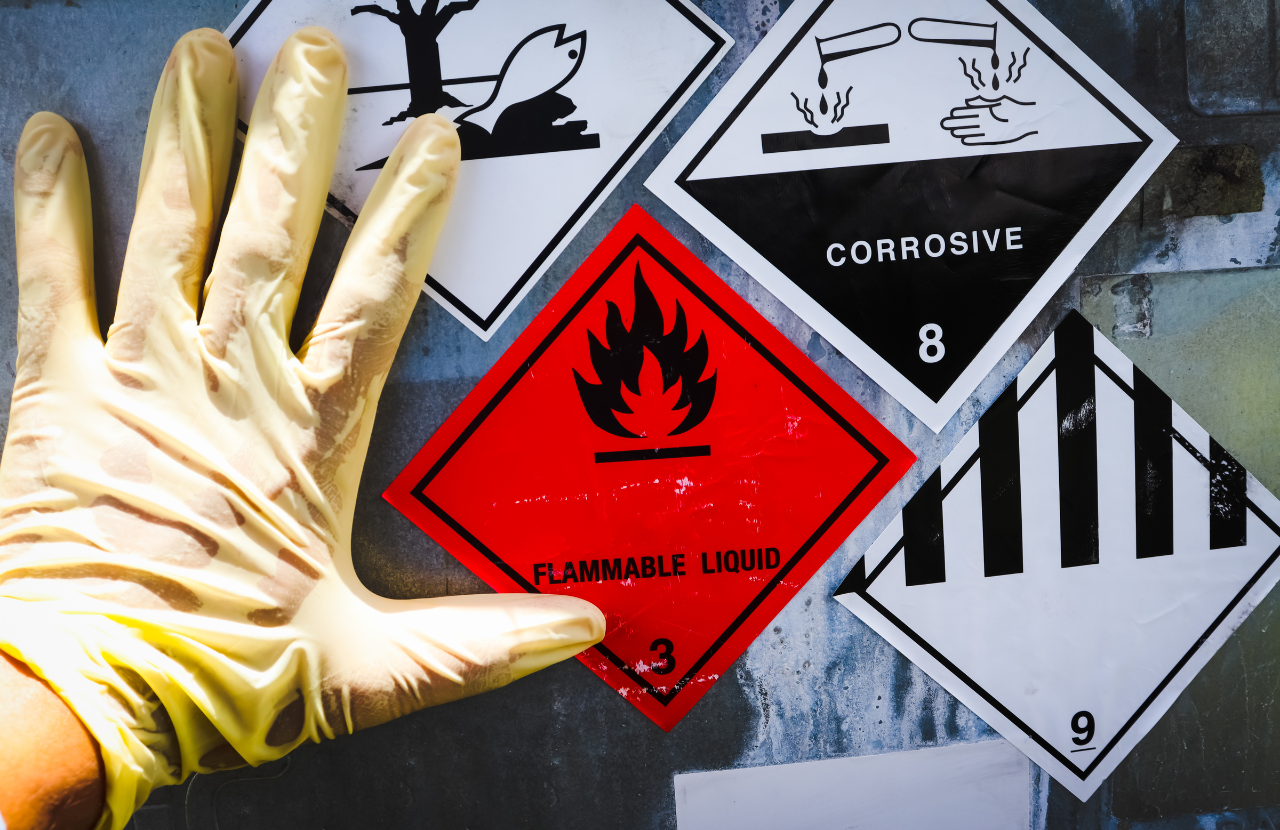

The Health and Safety Executive’s COSHH guidelines help employers understand how to safely manage hazardous substances in the workplace and comply with the Control of Substances Hazardous to Health Regulations 2002 (COSHH).
In this guide we explain the core principles underpinning COSHH guidance, legal duties and how to follow COSHH guidelines and regulations in practice.
What substances are covered by COSHH Regulations?
Under COSHH 2002, Regulation 2, a “substance hazardous to health” includes substances that can cause harm because of their hazardous properties or the way they are used in the workplace.
This includes substances that are:
- Classified as hazardous under chemical classification rules
- Assigned a workplace exposure limit (WEL)
- Biological agents such as bacteria, viruses, or fungi
- Dusts present at a substantial concentration in air
- Harmful because of their chemical or toxicological properties or the way they are used or present at work
Examples may include cleaning chemicals, solvents, paints, welding fumes, silica dust, flour dust, wood dust, gases, vapours, mists, and biological agents.
COSHH applies wherever these substances arise from work activities, including construction, manufacturing, engineering, healthcare, laboratories, cleaning, warehousing, agriculture, and food production.
It is important to note that some hazards are controlled under separate regulations rather than COSHH, including asbestos, lead, and radioactive substances.
What are employers’ and employees’ duties under COSHH?
Under the COSHH Regulations 2002, employers are responsible for assessing risks, preventing or adequately controlling exposure to hazardous substances, maintaining control measures, providing suitable training and PPE, and monitoring worker health where required.
Employees also have responsibilities under COSHH, including following training and safety procedures, using control measures and PPE correctly, reporting defects or concerns, and cooperating with their employer to help maintain a safe workplace.
For a more detailed explanation of COSHH duties, read our guide on COSHH Employers’ and Employees’ Responsibilities.
What are COSHH guidelines UK?
UK COSHH guidelines are published by the Health and Safety Executive (HSE) to help employers comply with the COSHH Regulations 2002 and safely manage hazardous substances in the workplace.
HSE COSHH guidance includes:
COSHH Basics
COSHH Basics is a general introduction to COSHH and explains how hazardous substances can affect workers’ health.
The guidance covers common workplace hazards such as chemicals, dusts, fumes, vapours, gases, and biological agents, alongside the main legal duties placed on employers under the COSHH Regulations.
COSHH Basics also explains the hierarchy of controls, including eliminating hazardous substances, using safer alternatives, improving ventilation, and providing PPE where necessary.
How to Carry Out a COSHH Risk Assessment
How to Carry Out a COSHH Risk Assessment explains how employers should identify hazardous substances, assess exposure risks, and decide what controls are required to protect workers.
This guidance discusses how to use safety data sheets (SDS), identify who may be exposed, consider how exposure occurs, and determine whether existing controls are effective. It also helps employers to determine when COSHH assessments should be reviewed.
COSHH Essentials
COSHH Essentials provides practical control guidance sheets for common hazardous tasks and processes across different industries. The guidance helps employers match hazardous substances with appropriate controls, such as local exhaust ventilation (LEV), containment systems, safe handling procedures, and respiratory protection.
COSHH Essentials is particularly useful for small and medium-sized businesses that need straightforward guidance on controlling exposure risks.
COSHH and Your Industry
COSHH and Your Industry contains industry-specific COSHH guidance for sectors such as construction, healthcare, manufacturing, engineering, woodworking, cleaning, and food production.
This guidance explains the hazardous substances commonly encountered in each sector, including silica dust, flour dust, welding fumes, cleaning chemicals, and biological agents, alongside practical examples of suitable control measures.
What the Law Says
What the Law Says explains employers’ legal duties under COSHH Regulations 2002 and related health and safety legislation. This includes duties to assess risks under Regulation 6, prevent or adequately control exposure under Regulation 7, maintain and test control measures under Regulation 9, and provide health surveillance under Regulation 1, where appropriate.
COSHH Frequently Asked Questions
COSHH Frequently Asked Questions answers common questions about COSHH compliance, including how to complete COSHH assessments, when safety data sheets are required, how long records should be kept, and when health surveillance is necessary.
These FAQs address common misunderstandings around PPE, ventilation, exposure monitoring, and the responsibilities employers have for protecting workers from hazardous substances.
COSHH Case Studies
COSHH Case Studies provides real-world examples of COSHH risks and control measures involving activities such as welding, soldering, woodworking, spray painting, and working with isocyanates.
The case studies demonstrate how exposure to hazardous substances can occur in practice and show the control measures organisations have implemented to reduce health risks and improve compliance.
COSHH Resources
COSHH Resources links to additional HSE publications, Approved Codes of Practice (ACOPs), research reports, and technical guidance covering hazardous substances, local exhaust ventilation (LEV), respiratory protective equipment (RPE), exposure limits, and safe storage.
These resources provide more detailed technical guidance for employers managing higher-risk substances or complex work activities.
COSHH guidelines golden rules
HSE COSHH guidance focuses on the following core principles to help employers prevent or adequately control exposure to hazardous substances.
Identify hazardous substances
Employers should identify all hazardous substances used or generated in the workplace, including chemicals, cleaning products, dusts, fumes, vapours, gases, and biological agents.
HSE guidance recommends gathering information from several sources to understand the risks associated with hazardous substances and determine what controls may be required, including:
- Safety data sheets (SDS) – provide information about hazards, exposure risks, emergency procedures, and recommended control measures.
- Product labels – identify hazard warnings, symbols, and precautionary statements.
- Manufacturer instructions – explain how substances should be safely used and controlled, including PPE or ventilation requirements.
- Workplace observations – help identify how substances are used in practice, who may be exposed, and whether existing controls are effective.
Carry out COSHH assessments
Under COSHH Regulation 6, employers must carry out suitable and sufficient COSHH assessments. HSE guidance explains that COSHH assessments should identify:
- The hazardous substances present – including substances used directly in the workplace and substances generated during work activities, such as dusts, fumes, vapours, or mists.
- How exposure could occur – for example through inhalation, skin contact, ingestion, or accidental release during handling, storage, or disposal.
- Who may be exposed – including employees, contractors, cleaners, maintenance workers, visitors, or other people who could be affected by hazardous substances.
- Existing control measures – such as ventilation systems, extraction equipment, enclosed processes, safe systems of work, or PPE already in place to reduce exposure.
- Additional actions required to reduce risks – including improvements to controls, additional training, health surveillance, maintenance, or changes to working methods where risks are not adequately controlled.
Under COSHH Regulation 6(3), assessments must be reviewed where they are no longer valid or where there has been a significant change to the work, substances used, or control measures.
Prevent or adequately control exposure
Under COSHH Regulation 7, employers must prevent exposure to hazardous substances where reasonably practicable or adequately control exposure where prevention is not possible.
HSE guidance promotes the hierarchy of controls, which prioritises the most effective control measures in the following order:
- Eliminate the hazard – remove the hazardous substance or process entirely.
- Substitute safer alternatives – replace hazardous substances with less harmful options where possible.
- Use engineering controls – reduce exposure using controls such as local exhaust ventilation (LEV), enclosed systems, or barriers.
- Introduce administrative controls – reduce risks through safe systems of work, supervision, procedures, and training.
- Use PPE where residual risks remain – provide suitable respiratory protection, gloves, eye protection, or protective clothing where other controls cannot fully reduce exposure.
PPE is the last line of defence because it reduces exposure but does not remove the hazard itself.
Store hazardous substances safely
COSHH storage guidelines recommend that hazardous substances should be clearly labelled, stored in suitable containers, and segregated where incompatible substances could react dangerously.
Storage areas should be secure, protected from damage, and well-ventilated where appropriate. Employers should ensure workers can access relevant safety information and emergency procedures.
Depending on the substances present, additional controls such as spill kits, eyewash stations, fire precautions, or specialist storage cabinets may also be required.
Maintain and test control measures
Under COSHH Regulation 9, employers must ensure control measures are maintained in efficient working order, good repair, and a clean condition.
Certain controls, including local exhaust ventilation (LEV) systems and some forms of respiratory protective equipment (RPE), must also be thoroughly examined and tested at suitable intervals. For example, most LEV systems require formal testing at least every 14 months, although more frequent testing may be necessary depending on the work activity and substances involved.
Employers should keep suitable inspection, maintenance, and testing records to demonstrate that controls remain effective.
Provide health surveillance where required
Under COSHH Regulation 11, employers may need to provide health surveillance where workers are exposed to substances linked to identifiable diseases or adverse health effects.
Depending on the risks involved, this may include skin checks, respiratory questionnaires, lung function testing, biological monitoring, or medical examinations.
Health surveillance helps identify early signs of work-related ill health before conditions become serious and may be required where workers are exposed to substances linked to occupational asthma, dermatitis, or other occupational diseases.
Provide information, instruction, and training
Employees working with hazardous substances should receive suitable training covering:
- The hazardous substances used and associated health risks
- COSHH control measures such as ventilation, extraction systems, and PPE
- Emergency procedures for spills, leaks, or accidental exposure
- Safe handling procedures and disposal arrangements
- PPE Training so they know how and when PPE should be used
HSE guidance explains that workers should understand the risks from hazardous substances, the outcome of COSHH assessments, and the precautions and control measures in place to protect them.
Improve safety and compliance with COSHH Training
Our online COSHH Training supports organisations to follow COSHH guidelines and comply with COSHH Regulations by helping employees understand exposure risks, follow safe working procedures, and use control measures correctly.
Written by our health and safety experts, the course is suitable for employees and contractors across a wide range of industries. The course is IOSH Approved, CPD Certified, and SCORM Compliant.
Find out more about COSHH Training on our website, or contact our friendly team today on 0203 011 4242 or [email protected]

Adam Clarke
Managing Director (Consulting)