

Understanding COSHH symbols is essential for anyone working with or managing hazardous substances. These hazard warning signs help people quickly identify dangers such as toxicity, flammability, or long-term health effects.
COSHH signs appear on a wide range of products, from everyday cleaning agents to industrial chemicals. This guide explains what COSHH symbols mean, why they are important, where you will see them and legal requirements.
What does COSHH mean?
COSHH stands for Control of Substances Hazardous to Health. It refers to the Control of Substances Hazardous to Health Regulations 2002, which require employers to identify, assess, and manage the risks from hazardous substances in the workplace.
To find out what the COSHH Regulations cover, and employers’ and employees’ responsibilities, please read our guide, What is COSHH?
What is the difference between COSHH and CLP?
CLP (Classification, Labelling and Packaging) refers to the GB CLP Regulation, which governs how chemicals are classified and labelled. This includes hazard symbols (pictograms), signal words (e.g. Danger, Warning), and hazard statements you see on packaging. CLP is based on the Globally Harmonised System of Classification and Labelling of Chemicals (GHS), meaning the symbols are used internationally.
COSHH (Control of Substances Hazardous to Health) refers to the Control of Substances Hazardous to Health Regulations 2002, which requires employers to assess and control the risks from hazardous substances in the workplace.
CLP tells you what the hazard is, while COSHH tells you what to do about it.
What are COSHH symbols?
“COSHH symbols” is a commonly used term, but the symbols are defined under CLP and not COSHH (see above). “COSHH symbols” are more accurately called “hazard pictograms”.
These hazard pictograms are often referred to as COSHH symbols because they are used to identify hazards and inform COSHH risk assessments in the workplace.
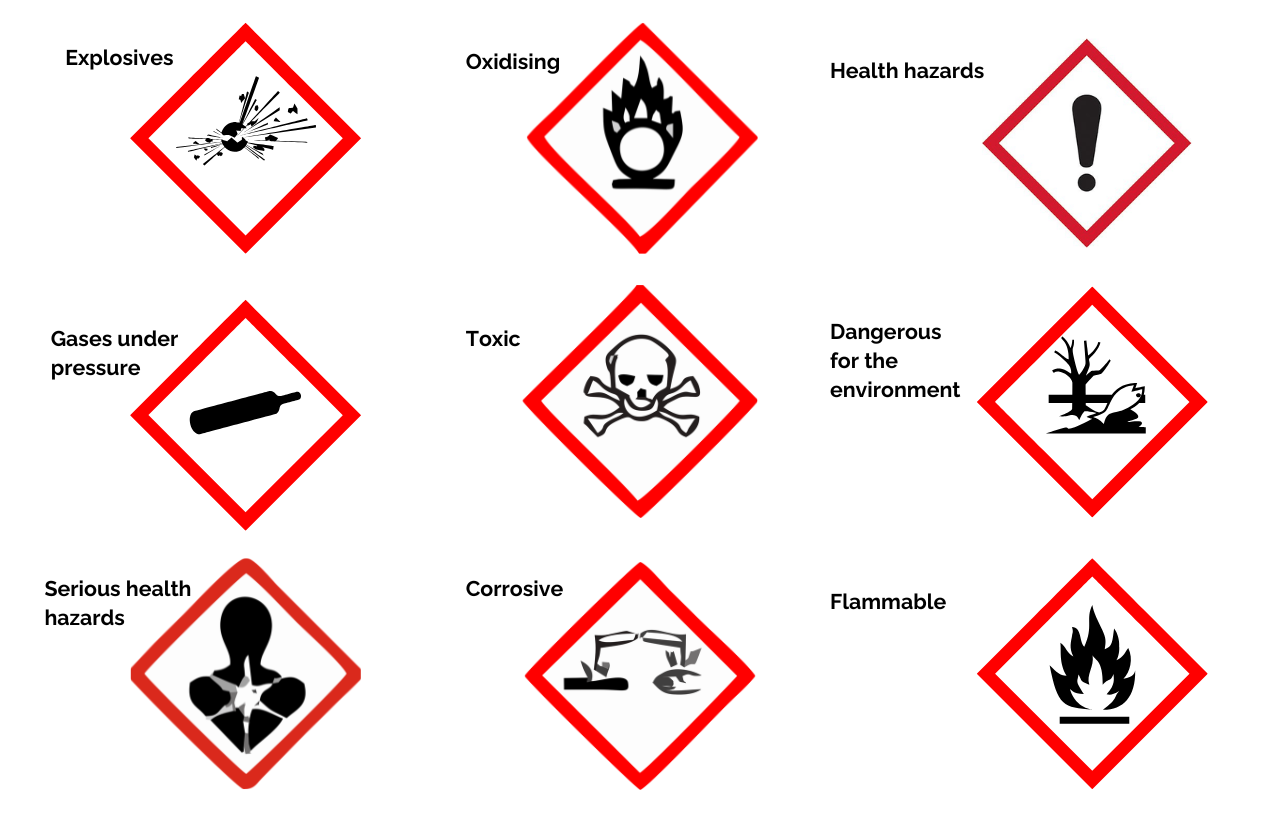
The table below shows the nine hazard pictograms used in the UK, including what each symbol looks like and the risks they indicate.
| Symbol Name | Visual Description | Primary Risk |
|---|---|---|
| Explosives | Exploding bomb | Explosive or self-reactive substances |
| Oxidising | Flame over a circle | Can cause or intensify fire |
| Health hazards | Exclamation mark | Irritation, sensitisation, harmful effects |
| Gases under pressure | Gas cylinder | May explode if heated |
| Toxic | Skull and crossbones | Toxic or fatal if inhaled, swallowed, or absorbed |
| Dangerous for the environment | Dead tree and fish | Harmful or toxic to aquatic life |
| Serious health hazards | Person silhouette with star | Long-term health effects, such as cancer, organ damage, or respiratory sensitisation |
| Corrosive | Liquid on hand/surface | Severe skin burns, eye damage, and corrosion of metals |
| Flammable | Flame | Easily ignited gases, liquids, solids, or vapours |
Explosives
Indicates substances that can explode if exposed to heat, shock, friction, or sparks. These materials are highly unstable and require strict control measures, including specialist storage, segregation, and handling procedures.
Examples: Fireworks, ammunition, organic peroxides, certain industrial reactive chemicals.
Oxidising
Shows substances that can cause or intensify fires by releasing oxygen. They may not burn themselves but will make other materials burn more fiercely.
Examples: Concentrated hydrogen peroxide, oxygen cylinders, nitrates (fertilisers).
Health hazard (less serious)
The exclamation mark health hazard sign indicates substances that may cause irritation, allergic reactions, or less severe toxicity. Effects may include skin irritation, eye irritation, or respiratory discomfort.
Examples: Cleaning products, detergents, adhesives, lower-risk solvents.
Gases under pressure
Warns of gases stored under pressure that may explode if heated or cause injury if released suddenly. Some can also cause cold burns.
Examples: CO₂ cylinders, propane tanks, oxygen cylinders, compressed air systems.
Toxic
The skull and crossbones toxic symbol identifies substances that can be fatal or cause severe poisoning even in small amounts through inhalation, ingestion, or skin contact.
Examples: Cyanide, carbon monoxide, certain pesticides, methanol.
Dangerous for the environment
The tree and fish symbol shows substances that are harmful to the environment, particularly aquatic life, often with long-lasting effects.
Examples: Oil, pesticides, mercury, industrial chemicals released into waterways.
Serious health hazard
Indicates substances that can cause long-term or severe health effects, often not immediately visible. Risks include cancer, respiratory sensitisation, reproductive harm, or organ damage.
Examples: Asbestos, benzene, silica dust, isocyanates.
Corrosive
Indicates chemicals that can cause severe skin burns, eye damage, and corrosion of metals. Immediate contact can result in serious injury.
Examples: Sulphuric acid, hydrochloric acid, sodium hydroxide, strong cleaning agents.
Flammable
Used for substances that ignite easily and burn rapidly, even at low temperatures. Vapours may also ignite and travel to ignition sources.
Examples: Petrol, ethanol, acetone, paints, aerosols, solvents.
How to recognise and understand hazard symbols
Hazard symbols (COSHH symbols) are visual indicators of risk, designed to quickly show the type of hazard present. On their own, they are just pictograms, but they are part of a wider labelling system.
Under the GB CLP Regulation, each symbol is accompanied by:
- Signal words such as Danger or Warning
- Hazard statements describing the risk (e.g. “Causes severe skin burns”)
- Precautionary statements explaining how to handle the substance safely
This information is shown on product labels (such as containers, bottles, and packaging) and in Safety Data Sheets (SDS) supplied with hazardous substances.
All hazard pictograms follow a consistent format, making them easy to recognise:
- A red diamond border to indicate danger
- A white background for clarity
- A black symbol showing the type of hazard
Each of the nine symbols represents a different hazard category. When combined with the full label and safety data, they help you understand both the risk and the appropriate control measures.
Where you find COSHH symbols
COSHH hazard labels and hazardous substance signs are anywhere chemicals are stored, used, or handled. Common locations include:
- Laboratories – on reagent bottles, chemical containers, and fume cupboard storage, often alongside detailed Safety Data Sheets (SDS)
- Factories and warehouses – on bulk containers, drums, pipelines, storage tanks, and designated chemical storage areas
- Cleaning cupboards – on everyday products such as bleach, descalers, and disinfectants, which are often irritant or corrosive
- Healthcare settings – on disinfectants, sterilising agents, medical gases, and laboratory samples
- Construction sites – on materials such as paints, adhesives, sealants, fuels, and cement products
- Transport and delivery containers – including vehicle tanks, drums, and intermediate bulk containers (IBCs) used to move hazardous substances
- Decanted or secondary containers – such as spray bottles or smaller containers used for day-to-day tasks
- Storage cabinets and chemical stores – to indicate the types of hazards present within the area
Requirements for displaying and maintaining hazard symbols
Any workplace using hazardous substances must ensure that hazard symbols and labels are clear, accurate, and maintained, so risks can be identified and controlled effectively.
Under the Control of Substances Hazardous to Health Regulations 2002 and the GB CLP Regulation, there are specific expectations around how this information is presented and managed.
Legibility and clarity
Under COSHH Regulation 12 (Information, instruction and training), employers must ensure that employees are provided with information that is comprehensible and accessible. This means labels and symbols must be easy to read, clearly visible, and not obscured by damage, dirt, or poor placement.
Correct labelling
The GB CLP Regulation sets out detailed labelling requirements, particularly under Article 17 (General rules for labelling) and Article 19 (Pictograms). These require hazardous substances to display the correct hazard pictograms, signal words, and hazard/precautionary statements.
Where substances are transferred into secondary containers, they must still be labelled to reflect the same hazards.
Maintenance and condition
Under COSHH Regulation 7 (Prevention or control of exposure), employers must ensure that control measures remain effective. This includes maintaining labels and signage, so they remain accurate and legible. Damaged or missing labels must be replaced promptly.
Visibility and placement
CLP requires labels to be firmly affixed and clearly visible on packaging (Article 31 – rules on packaging and labelling presentation). This means hazard symbols must be positioned so they can be seen at the point of storage and use, enabling workers to identify risks before exposure occurs.
Information, instruction and training
COSHH Regulation 12 requires employers to ensure employees understand the hazards and precautions. This includes training on hazard symbols, access to Safety Data Sheets (SDS), and clear safe systems of work.
Why are COSHH symbols important?
Understanding what COSHH symbols mean is essential for recognising risks quickly.
Data from the Health and Safety Executive shows that around 84,000 people in Great Britain have dermatitis caused or exacerbated by their work, one of the most common forms of occupational ill health. Many of these cases are linked to exposure to hazardous substances such as chemicals, cleaning agents, and solvents.
Recognising hazard symbols on chemicals is important because it helps to:
- Prevent injuries and ill health by alerting workers to risks such as burns, poisoning, or skin and respiratory exposure
- Support effective risk assessments by clearly identifying hazards before work begins
- Ensure legal compliance with regulations such as COSHH and CLP
- Enable faster, safer decision-making, especially where time pressure or unfamiliar substances are involved
Why hazard symbols changed in the UK
Older UK hazard symbols were displayed as orange squares under the CHIP (Chemicals (Hazard Information and Packaging for Supply) regulations. These were phased out in 2015 to align the UK with a consistent, global system for identifying chemical hazards.
The old symbols were replaced by red diamond pictograms under the Globally Harmonised System of Classification and Labelling of Chemicals (GHS), implemented in the UK through the GB CLP Regulation. Hazard symbols are now standardised and easily recognised across different countries, supporting safety in international supply chains and workplaces.
Support safer working with COSHH training
Our COSHH training course provides a practical understanding of how to assess and control risks from hazardous substances in the workplace. It covers carrying out COSHH risk assessments, legal responsibilities, and the interpretation of key safety information such as labels, Safety Data Sheets, and COSHH symbols in context.
The course supports employees and managers, helping ensure hazardous substances are handled, stored, and used safely across different working environments.
Find out more about COSHH training on our website, or contact our friendly team on 0203 011 4242 / [email protected]

Adam Clarke
Managing Director (Consulting)