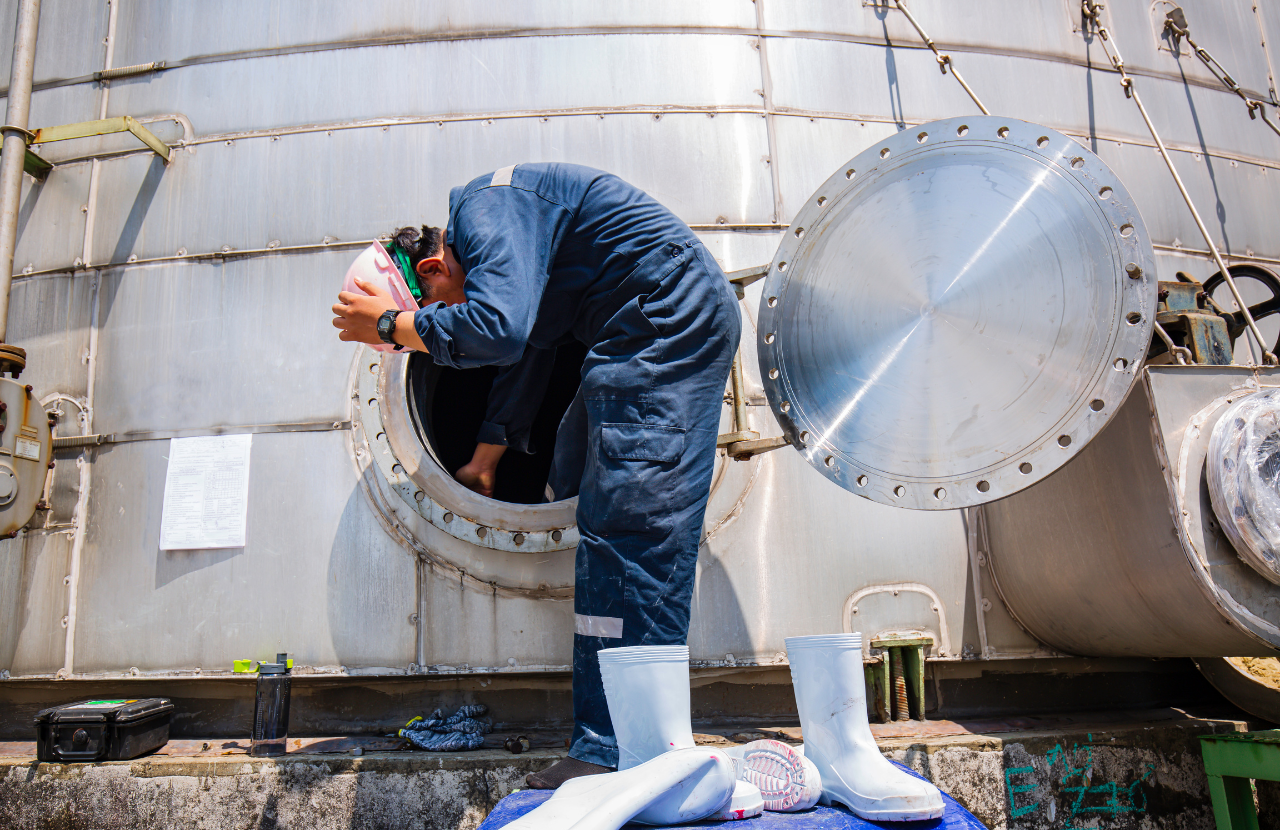

The Confined Spaces Regulations 1997 set out important legal requirements for organisations whose employees work in or around confined spaces.
For those responsible for health and safety, supervising confined space work, or reviewing existing arrangements, a clear understanding of the regulations can help identify gaps, strengthen controls, and improve the management of confined space activities.
This guide explains the Confined Spaces Regulations 1997, including employer responsibilities, specified risks, and the practical measures organisations can implement to improve safety, support compliance, and reduce the likelihood of serious incidents.
What are the Confined Spaces Regulations 1997?
The Confined Spaces Regulations 1997 are the primary UK regulations governing work in confined spaces. These regulations apply wherever a confined space presents a reasonably foreseeable risk of serious injury.
The regulations establish a framework for managing confined space risks and set out the following requirements for employers:
Avoid confined space entry wherever reasonably practicable
Regulation 4(1) requires employers to avoid confined space entry wherever reasonably practicable.
Before allowing workers to enter a confined space, employers must consider whether the work can be completed safely using alternative methods that eliminate the need for entry.
Assess and control risks
While the Confined Spaces Regulations 1997 do not contain an explicit risk assessment requirement, compliance with Regulation 4 requires employers to understand the risks present and develop a safe system of work. In practice, carrying out a suitable risk assessment is the primary way of identifying risks and determining the control measures needed to manage them safely.
This approach is supported by the Management of Health and Safety at Work Regulations 1999, Regulation 3, which requires employers to carry out suitable and sufficient assessments of the risks to employees and others arising from their work activities.
For confined space work, this means identifying hazards such as oxygen deficiency, toxic gases, fire and explosion risks, flooding, heat stress, engulfment, and restricted escape routes, then determining the precautions necessary to reduce those risks to an acceptable level.
Implement a safe system of work
Regulation 4(2) requires employers to ensure that work in confined spaces is carried out in accordance with a safe system of work. The system of work must, so far as is reasonably practicable, reduce any relevant specified risks (see ‘What is a specified risk under the Confined Spaces Regulations 1997?’ below).
Depending on the nature of the work, a safe system of work may include permit-to-work procedures, atmospheric testing, ventilation, isolation of services, personal protective equipment, communication arrangements, and competent supervision.
Establish emergency arrangements
Regulation 5 requires employers to make suitable and sufficient arrangements for people to be rescued in an emergency.
Rescue procedures should be planned before work begins and be appropriate to the confined space, the work being undertaken, and the risks identified during the risk assessment.
Emergency arrangements may include rescue equipment, retrieval systems, breathing apparatus, first aid provisions, communication systems, and trained personnel capable of carrying out a rescue if required.
What is a confined space under the regulations?
The Confined Spaces Regulations 1997, Regulation 1(2) define a confined space as:
“Any place, including any chamber, tank, vat, silo, pit, trench, pipe, sewer, flue, well or other similar space in which, by virtue of its enclosed nature, there arises a reasonably foreseeable specified risk.” (see ‘What is a specified risk under the Confined Spaces Regulations 1997?’ below).
The key consideration is not the size of the space, but whether its enclosed nature creates a foreseeable risk of serious injury.
Common confined space examples include:
- Storage tanks
- Silos
- Sewers
- Utility chambers
- Manholes
- Boilers
- Pipework systems
- Reaction vessels
- Crawl spaces
- Underground chambers
For more information, please read our article, What is the definition of a confined space?
What is a specified risk under the Confined Spaces Regulations 1997?
A confined space only falls within the scope of the regulations if there is a reasonably foreseeable specified risk.
The regulations identify the following specified risks:
| Specified risk (Regulation 1(2)) | Examples |
| Serious injury arising from a fire or explosion | Flammable gases, vapours, combustible dusts |
| Loss of consciousness arising from an increase in body temperature | Hot processes, poor ventilation, high ambient temperatures |
| Loss of consciousness or asphyxiation arising from gas, fume, vapour, or lack of oxygen | Oxygen deficiency, toxic gases, fumes, vapours |
| Drowning arising from an increase in the level of liquid | Rising liquids, flooding, water ingress |
| Asphyxiation arising from a free-flowing solid or the inability to reach a respirable environment due to entrapment by a free-flowing solid | Grain silos, sand hoppers, free-flowing solids |
How employers can comply with the Confined Spaces Regulations
Complying with the Confined Spaces Regulations 1997 requires employers to implement practical measures that help ensure confined space work is carried out safely.
Risk assessment
Before any confined space work takes place, employers should assess the specific hazards associated with the space and the planned activity.
The assessment should first determine whether entry can be avoided and, where it cannot, identify hazards such as atmospheric risks, fire and explosion, flooding, heat stress, engulfment, and potential difficulties with escape or rescue.
For more information about confined spaces risk assessments, and a downloadable template, please see: Confined space risk assessment: a comprehensive guide
Competence, training, and supervision
Anyone involved in confined space work should have the knowledge, training, and experience necessary to carry out their role safely.
Employers should ensure that workers understand the hazards present, the precautions required, and the emergency procedures that apply to the task. Appropriate supervision should also be provided throughout the work activity.
Permit-to-work systems
Many organisations use permit-to-work systems to control confined space entry.
A permit helps ensure that work is properly authorised and that essential safety precautions have been completed before entry is permitted. This may include confirming atmospheric test results, isolation arrangements, emergency procedures, and the personnel authorised to carry out the work.
Isolation of services and equipment
Before work begins, employers should ensure that any services or equipment that create additional risks are properly isolated. This may include electrical systems, gas supplies, pipework, steam systems, liquids, or moving machinery that could introduce hazards into the confined space during the work activity.
Atmospheric testing and monitoring
Atmospheric testing is often required before workers enter a confined space and may need to continue throughout the work activity. Monitoring helps identify hazards such as oxygen deficiency, toxic gases, and flammable atmospheres that may not be visible or detectable without specialist equipment.
Ventilation
Where hazardous atmospheres could develop, employers may need to provide mechanical or forced ventilation.
Effective ventilation can help maintain safe oxygen levels, remove harmful gases and vapours, reduce heat build-up, and improve overall air quality within the confined space.
Communication arrangements
Workers inside a confined space should be able to maintain effective communication with those outside the space throughout the work activity. Depending on the environment, this may involve radios, hard-wired communication systems, visual signals, or other suitable methods.
Effective communication helps ensure that hazards, changes in conditions, and emergencies can be identified and responded to quickly.
Personal protective equipment (PPE)
Depending on the hazards identified during the risk assessment, workers may require personal protective equipment (PPE) to help protect them while working in a confined space. This may include safety helmets, gloves, eye protection, safety footwear, respiratory protective equipment (RPE), breathing apparatus, fall arrest equipment, and gas detection devices.
PPE should be selected based on the specific risks present and used alongside other control measures, such as ventilation, atmospheric monitoring, and safe systems of work.
Emergency and rescue arrangements
Rescue procedures should be planned before work begins and be appropriate to the confined space, the work being undertaken, and the risks identified during the assessment.
Depending on the circumstances, emergency arrangements may include rescue equipment, retrieval systems, breathing apparatus, first aid provisions, communication systems, and personnel trained to carry out a rescue if required.
Can employers rely on the emergency services for confined space rescue?
Employers must make suitable and sufficient arrangements for the rescue of persons in the event of an emergency, as required by the Confined Spaces Regulations 1997, Regulation 5.
While the emergency services may form part of an organisation’s emergency planning, employers should not assume that external rescue services alone will provide an adequate response. Health and Safety Executive (HSE) guidance in L101: Safe Work in Confined Spaces notes that employers should not rely on emergency services as they may not respond quickly enough.
Confined space incidents can escalate rapidly. Hazards such as oxygen deficiency, toxic gases, flooding, engulfment, and heat stress can cause serious injury or death within minutes, making a prompt rescue essential.
Rescue arrangements should be planned before work begins and be appropriate to the confined space, the work being undertaken, and the risks identified during the assessment. Depending on the circumstances, this may include trained personnel, rescue equipment, retrieval systems, breathing apparatus, first aid provisions, and communication systems.
The HSE also emphasises that rescue arrangements should be rehearsed where appropriate and that everyone involved should understand their roles and responsibilities in the event of an emergency.
What are training requirements under Confined Spaces Regulations?
Employers have legal duties under the Health and Safety at Work etc. Act 1974 and the Management of Health and Safety at Work Regulations 1999 to provide the information, instruction, training, and supervision necessary to protect employees.
Training is also fundamental to compliance with the Confined Spaces Regulations 1997. Employers must ensure that work is carried out in accordance with a safe system of work under Regulation 4(2) and that suitable and sufficient emergency arrangements are in place under Regulation 5. In practice, this requires those involved in confined space work to be competent to perform their duties safely.
What year did the Confined Spaced Regulations come into effect?
The Confined Spaces Regulations 1997 came into force on 28 January 1998 and remain the principal legislation governing confined space work in Great Britain today.
What are the Confined Space Regulations 2021?
There are no UK regulations called the Confined Space Regulations 2021.
In Great Britain, work in confined spaces is governed by the Confined Spaces Regulations 1997. References to ‘Confined Space Regulations 2021’ are often the result of confusion with updated guidance, training standards, or legislation in other countries.
Do the Confined Spaces Regulations apply in Ireland?
The Confined Spaces Regulations 1997 apply in Great Britain.
In the Republic of Ireland, confined space work is governed by the Safety, Health and Welfare at Work (Confined Spaces) Regulations 2001. Although the legislation is different, it follows many of the same principles as the UK regulations, including the need to assess risks, avoid entry where possible, implement safe systems of work, and establish suitable emergency rescue arrangements.
Organisations operating across multiple jurisdictions should ensure they understand and comply with the specific legal requirements that apply in each country.
Confined Spaces Regulations 1997 Summary
- The Confined Spaces Regulations 1997 are the primary UK regulations governing work in confined spaces and came into force on 28 January 1998.
- A confined space only falls within the scope of the regulations if its enclosed nature creates a reasonably foreseeable specified risk.
- Specified risks include fire and explosion, loss of consciousness from heat, toxic gases or lack of oxygen, drowning, and asphyxiation or entrapment caused by free-flowing solids.
- The regulations require employers to avoid confined space entry wherever reasonably practicable.
- Where entry cannot be avoided, employers must implement a safe system of work and appropriate control measures.
- Practical controls may include risk assessments, permit-to-work systems, atmospheric testing, ventilation, isolation procedures, PPE, communication arrangements, and competent supervision.
- Employers must establish suitable and sufficient emergency rescue arrangements before work begins.
- Employers should not rely solely on the emergency services and should ensure rescue arrangements can be implemented without unnecessary delay.
Confined Space Training for safer working practices
Working in confined spaces presents unique risks that require careful planning, competent workers, and effective control measures. Our online Confined Space Training helps employees and contractors understand the hazards associated with confined space work and the practical steps needed to work safely.
Designed for organisations whose employees work in or around confined spaces, the course supports awareness of the Confined Spaces Regulations 1997, safe systems of work, emergency arrangements, and the responsibilities that help keep people safe.
With a short assessment and downloadable certificate, it is a practical way to strengthen safety awareness and promote safer working practices across your organisation.
Find out more about Confined Space Training on our website, or contact our friendly team today on 0203 011 4242 / [email protected]

Adam Clarke
Managing Director (Consulting)