
Understanding fire extinguisher colours helps you quickly recognise whether an extinguisher is suitable for a particular type of fire. In an emergency, using the wrong extinguisher can make a fire worse or put people at serious risk.
In the UK, portable fire extinguishers follow a standard colour identification system, where the label or band indicates the extinguishing agent and the types of fires it can tackle.
This guide explains the fire extinguisher colours used in the UK so you can identify the correct extinguisher when it matters.
What are the colours of fire extinguishers in the UK?
In the UK, fire extinguishers follow a standard colour identification system.
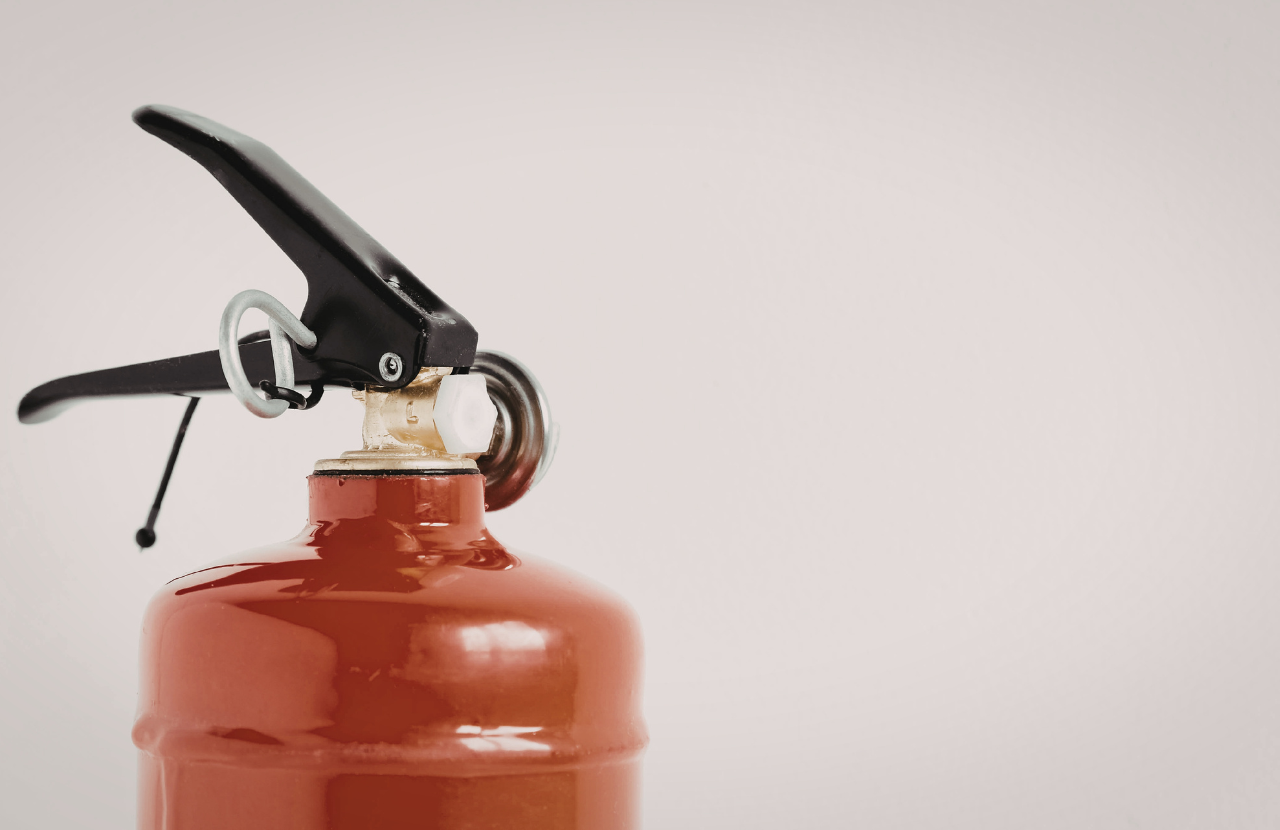
Under BS EN3, the body of the extinguisher must be at least 95% red, with a coloured label or band identifying the extinguishing agent.
The main fire extinguishers are:
- Red label – Water extinguisher
- Cream label – Foam extinguisher
- Blue label – Dry powder extinguisher
- Black label – Carbon dioxide (CO2) extinguisher
- Yellow label – Wet chemical extinguisher
These colour indicators enable users to quickly identify the correct extinguisher during an emergency.
Why are UK fire extinguishers mostly red?
The BS EN3 standard requires portable fire extinguishers to have a red body covering at least 95% of the cylinder. The extinguishing agent inside is then identified by a coloured label or band.
Before this standard was introduced, fire extinguishers in the UK were often fully colour coded. For example, water extinguishers were red, foam extinguishers were cream, powder extinguishers were blue, and CO₂ extinguishers were black. While this system helped identify extinguisher types, it varied between manufacturers and countries.
The introduction of BS EN3 created a consistent European standard, ensuring that extinguishers are easily recognisable in an emergency and that their appearance is standardised across different countries.
The red body improves visibility, making extinguishers easier to locate quickly during a fire.
Fire extinguisher colour chart
| Extinguisher Colour | Type | Best For (Fire Class) | Do Not Use On |
| Red label | Water | Class A (wood, paper, textiles) | Electrical fires, flammable liquids Note: Some water extinguishers use water mist technology and may be suitable for use on electrical fires where specifically tested and rated. Always check the extinguisher label before use. |
| Black label | CO2 | Electrical fires and Class B liquids | Cooking oils and fats |
| Blue label | Dry powder | Class A, B, C and electrical fires | Confined or enclosed spaces (breathing risk and reduced visibility) |
| Cream label | Foam | Class A and B (flammable liquids) | Live electrical equipment |
| Yellow label | Wet chemical | Class F (cooking oils and fats) and Class A | Flammable gases. Also unsuitable for electrical fires (unless specifically rated) |
What is a red label fire extinguisher used for?
A red label fire extinguisher (or ‘water extinguisher’) is used for Class A fires, which involve solid combustible materials.
This includes the following fires:
- Wood
- Paper
- Textiles
- Cardboard
Standard water extinguishers work by cooling the burning material and reducing the temperature below the point at which combustion can continue. They are commonly installed in offices, schools, warehouses and shops.
These extinguishers must not be used on flammable liquid fires (Class B) or live electrical equipment, as this can spread the fire or create a risk of electric shock.
Some newer water extinguishers use water mist technology, which produces a fine spray of droplets. These can be more versatile and, where specifically tested and rated, may be suitable for use on electrical fires. However, users should always check the extinguisher label and instructions before use.
What colour is a CO2 fire extinguisher?
In the UK, a carbon dioxide (CO2) fire extinguisher is a red extinguisher with a black label or band.
CO2 extinguishers are commonly used for:
- Electrical fires
- Offices and workplaces with electrical equipment
- Server rooms and IT facilities
- Flammable liquid fires (Class B)
Carbon dioxide works by displacing oxygen around the fire and cooling the burning material, which helps stop combustion. Since CO2 does not leave residue, it is particularly suitable for electrical equipment.
CO2 extinguishers are not suitable for Class F fires involving cooking oils and fats, and they are generally less effective on fires involving solid combustible materials such as wood or paper.
What colour fire extinguisher is used for electrical fires?
In the UK, CO₂ extinguishers (black label) are commonly used for electrical fires.
Dry powder extinguishers, identified by a blue label, can also be used on electrical fires. However, they are generally not recommended for indoor use, as the powder can impair visibility, contaminate equipment, and cause breathing irritation.
What is a blue label fire extinguisher used for?
A blue label fire extinguisher is a dry powder extinguisher. Dry powder extinguishers are often referred to as ABC extinguishers because they can be used on:
- Class A fires – solid combustible materials such as wood, paper, and textiles
- Class B fires – flammable liquids such as petrol, oil, and solvents
- Class C fires – flammable gases such as propane and butane
Dry powder extinguishers can also be used on electrical fires, so they are suitable for environments where multiple fire risks may be present.
Due to their versatility, blue-labelled dry powder extinguishers are commonly installed in industrial sites, garages and workshops, fuel storage areas and construction sites.
It is important to know that dry powder extinguishers are not recommended for use in enclosed indoor spaces, as the powder can reduce visibility, contaminate equipment, and cause breathing irritation.
What is a cream label fire extinguisher used for?
A cream label fire extinguisher is a foam extinguisher. Foam extinguishers can tackle:
- Class B fires involving flammable liquids such as petrol, oil, paint, and solvents
- Class A fires involving solid combustible materials such as wood, paper, and textiles
Foam extinguishers are commonly installed in environments where flammable liquids may be present, including offices, shops and retail premises, warehouses, and garages and workshops.
Foam works by forming a blanket over the surface of the burning liquid, which prevents oxygen from reaching the fuel and reduces the risk of re-ignition. At the same time, the water content of the foam helps cool the burning material.
Many foam extinguishers historically used AFFF (Aqueous Film Forming Foam), which can contain PFAS chemicals, including PFOA. Since July 2025, the use of firefighting foams containing PFOA or related substances has been prohibited in the UK. As a result, these types of foams can no longer be used, and organisations have had to replace them with suitable alternatives. These may include fluorine-free foam (F3), as well as other extinguisher types such as water mist, CO₂, or dry powder, depending on the specific fire risks and suitability for the environment.
Foam extinguishers must not be used on live electrical fires. They may only be used on electrical equipment that has been fully isolated from the power supply.
What is a yellow label fire extinguisher used for?
A yellow label fire extinguisher is a wet chemical extinguisher.
Wet chemical extinguishers tackle Class F fires, which involve cooking oils and fats. These types of fires commonly occur in commercial kitchens where deep fat fryers and cooking oils are used.
Wet chemical extinguishers are therefore commonly installed in:
- Commercial kitchens
- Restaurants
- Cafés and takeaway outlets
- Catering facilities
The extinguishing agent works by cooling the burning oil and reacting with the fuel to form a soap-like layer (a process known as saponification). This layer helps seal the surface of the oil, preventing oxygen from feeding the fire and reducing the risk of re-ignition.
Wet chemical extinguishers may also be suitable for some Class A fires involving solid combustible materials such as wood or paper, but they are primarily intended for use on cooking oil and fat fires.
Professional fire safety consultancy
Praxis42 experienced fire safety consultants help organisations identify fire risks, ensure appropriate firefighting equipment is in place, and comply with UK fire safety legislation, including the Regulatory Reform (Fire Safety) Order 2005.
Our consultants are BAFE SP205 certified and have extensive operational experience, including backgrounds with the London Fire Brigade. We provide practical, tailored fire risk assessments and clear recommendations to help you protect people, property, and business operations.
Learn more about Fire Safety Consultancy Services on our website, or talk to our friendly team today on 0203 011 4242 / [email protected]

Rob Sherman
Director of Fire Safety